Pages


Showing posts with label Non portraits. Show all posts

Sunday, March 12, 2023

Launch of THREADS at Coal Creek Community Park and Museum


What a fantastic turnout there was for the launch on Thursday evening of THREADS, The Stories We Weave at Coal Creek Community Park and Museum in South Gippsland. 


I only wish I’d taken more shots of the exhibition as a whole, but we found ourselves so engaged with the works and the lovely people we met, including Olivia O’Connor, whose extraordinary work Always Carry a Handkerchief, timber, oil paint, 2023, hangs next to mine, (pic #6) that time simply ran away from us. No doubt the museum will be posting photos of the evening’s highlights on their Instagram and Facebook pages, so you can head over there. Even better, a road trip is highly recommended. 


Last night’s personal highlights included reuniting with old friends, including Kim McDonald (pics #3 and #4). Kim and I go back a long way - we first met in the early 1980s as fellow art students. Kim and Jasmine Susic (seen in pic #7 with Shane Jones) have a terrific collaborative multi-media work in the exhibition, BLOOM - and the Sensate World, 2022.


I first met Cresside Collette (second from left, pic #4 above) soon after graduation from art school. As one of the invited artists, Cresside has several works in the show, including tapestries that were woven en plein air (pic #9). Her tapestry, Revealing Grace, 2000, is on the far right in pic #10. 


Huge thanks to curator Rachel Jones (pic #4, far right) for inviting me to be part of THREADS and to Coal Creek Community Park and Museum for their warm welcome and hospitality.

Thursday, January 5, 2023

Horn Poppy

Kicking off the working year: a linocut in progress, part of a series begun in 2022, draws inspiration from Horn Poppy, a wallpaper design by May Morris for Morris & Co., circa 1885. (Page view above, left).

A recurring motif in the prolific Morris’s work, the horned poppy was often incorporated into her embroidery designs. 


In September 2022, the first two works in the series were exhibited in the Goldfields Printmakers show, The Printmakers’ Garden of Imagination at Newstead Arts Hub, Newstead, Vic, and at IMPACT 12, the international printmaking symposium, in Bristol, UK. They can be viewed HERE.

Monday, November 1, 2021

A fine send off for BACKSTORIES

Following are some treasured memories of the last day of Backstories at Stephen McLaughlan Gallery on Sunday, October 31.

Upon arrival, I paused to photograph the welcoming vase of flowers outside Stephen’s gallery, a touch I’ve always loved. Just as I pressed the shutter, the man himself appeared in the doorway. 

Catching up with friends (views 2 - 5) was the highlight of the afternoon. In the group shot below, L-R, are Shane Jones, John Waller, Vanessa Taylor, Stephen McLaughlan, Damon Kowarsky, Priscilla Ambrosini and James Harrison. It was also terrific to chat to some of the folk (not pictured) who dropped by to collect the works they had acquired. 


Before heading home, Shane and I had an impromptu meal upstairs at Chloe’s Bar in the historic pub Young and Jackson (final view below). We practically had the place to ourselves - there were more staff than patrons - but we did get to hang out with the infamous Chloé, painted by Jules Joseph Lefebvre in 1875. Many thanks to the waiter who took the following shot.


Other photo credits for this post: myself, Shane Jones and James Harrison. 


All in all, it was a memorable day. 

Sunday, October 31, 2021

THE SUN SETS ON BACKSTORIES

After several extensions, all of them thwarted by lockdowns, Backstories, my solo show at Stephen McLaughlan Gallery, officially closes today.

Sunday, pictured above, takes its title from the song in the Pulitzer Prize winning musical drama, Sunday in the Park with George (1984, music and lyrics by Stephen Sondheim, book by James Lapine). The musical was inspired by the George Seurat painting, A Sunday Afternoon on the Island of La Grande Jatte (1884-86). The song, Sunday, closes both its first and second acts. As some of you know, my partner Shane Jones and I are devotees of Sondheim’s work, as is Stephen McLaughlan. Accordingly, it seems doubly fitting to post the painting here, as a swansong to my own show. 

Stephen, Shane and I are all supporters of Watch This, a visionary Melbourne-based theatre company that specialises in Sondheim’s works. The company’s 2019 production of Sunday in the Park with George was unforgettable. I saw it twice and on both occasions, the song brought tears to my eyes.  

Coincidentally, Watch This held two preview events, including their 2019 season launch of Sunday in the Park with George at Stephen Mclaughlan Gallery. Pictured below is the company’s founder and first Artistic Director, Sonya Suares, who also co-directed the production. That’s Shane and I on the left in the following view. (Photos courtesy Sonya Suares via Stephen McLaughlan, reproduced with his kind permission).


We were delighted that Sonya Suares was able to join us at the gallery for the memorable Backstories Artist Celebration on Saturday afternoon, July 31, 2021. Sonya and I are pictured with Sunday in the last photo below. (Photo credit: Julie Keating). 

After several postponements, the next Watch This production, Into the Woods, will be performed early next year at Melbourne Meat Market, running from Saturday January 15 - Sunday January 23. While Sondheim’s extraordinary revisionist take on fairy tales didn’t directly inspire my own fairy tale-related works (including the anthology of feminist fairy tales, There was once…)  it certainly added fuel to the fire. For further information about Into the Woods, including performance dates and times, visit Watch This HERE.

Before heading for Melbourne to farewell Backstories (see previous post) I’d like to extend one last thank you to Stephen McLaughlan, Shane Jones, the many people who visited the exhibition and those who have acquired works. Against all the odds, “on an ordinary Sunday”,* Backstories is finally having its fairy tale ending.

Backstories concludes today at 5pm.


*From Stephen Sondheim’s lyric for Sunday. To see the song performed in the original production of Sunday in the Park with George, go HERE.


Pictured top: Deborah Klein, Sunday, 2020, acrylic on linen, 40.5 x 30.5 cm. Photo credit: Tim Gresham.

Tuesday, October 26, 2021

A time for farewells

One Way (pictured above) is one of several drawings that had their genesis during a particularly productive residency at The Art Vault in Mildura in 2017. Little did I know, it would be my last ever residency there, as this unique, irreplaceable gallery is currently in the process of closing down. The Art Vault has been a big part of my life; I’ll miss it very much, as will countless others, especially the many other artists they nurtured and encouraged. 

Navigator, pictured left in the following view, is a more recent work and Chainmail on its right, was also completed during the 2017 Art Vault residency. 


It seems this is a time for farewells. All three works are part of my solo show, Backstories at Stephen McLaughlan Gallery which is coming out of lockdown to see out its final two days this coming weekend, 30 - 31 October. 


Photo credit for the above installation views at Stephen McLaughlan Gallery: Kathryn Ryan and Julie Keating. All works are ink and gouache on Khadi paper, 15.5 x 11 cm.


BACKSTORIES

Stephen McLaughlan Gallery

Level 8, Room 16, 37 Swanston Street

MELBOURNE 3000

Special viewing times:

Saturday October 30: 11 am - 5 pm

Sunday October 31: 1 - 5 pm

Saturday, March 20, 2021

Double, double

Pictured above, Double, double (as in toil and trouble*), the little work that’s been by far the biggest challenge of any of the paintings I’ve recently undertaken.

Double, double (2021, acrylic on two canvases, 17.5 x 25 cm) went through so many different stages, none of which remotely met my expectations, that I finally dismissed it as a heroic failure and moved on to other works.

I’ve learnt a great deal during the development of this picture. As it turned out, putting it aside was a good move. It gave me some sorely needed time and distance. Moreover, I was able to take what I gleaned from the making of other paintings in the series and apply some of it here. (In fact, all of the works so far have informed one other to some degree). 

Double, double has also proven frustratingly hard to photograph. At this stage, I’ve decided it is what it is. Nevertheless, the work does look significantly better in the flesh. For starters, there is a more even tonal balance between the two panels than appears here and the colours, built up over multiple layers, are somewhat richer.

I haven’t documented the many stages this painting has been through and wouldn’t inflict them on anyone even if I had. However, a handful of developmental shots are below. At one stage, my twin protagonists were intended to wear matching earrings based on an ornate gold pair I discovered in a catalogue of historic jewellery originating from the Victorian Goldfields (see last two photos). The inclusion of finely detailed, delicate areas of gold was intended to reflect the influence of Tudor portrait miniatures on this work. I laboured over the jewellery for several hours, only to realise it was an enormous distraction that would detract from the rest of the painting, most notably the intricately braided hair that’s central to it. As a result, I abandoned the earrings even before I’d finished painting them. In the end, I went with the relatively simple earrings shown in the finished work above. They are based on a pair I’ve owned for many years, although I’ve changed the gemstones from the original red stones (which I believe are coral) to my birth stone, turquoise.

*Song of the Witches, Macbeth, William Shakespeare, Act IV, Scene I.


Tuesday, March 2, 2021

Wayfarer

Pictured above: Wayfarer, 2021, diptych, acrylic on canvas, 37.5 x 15 cm overall.

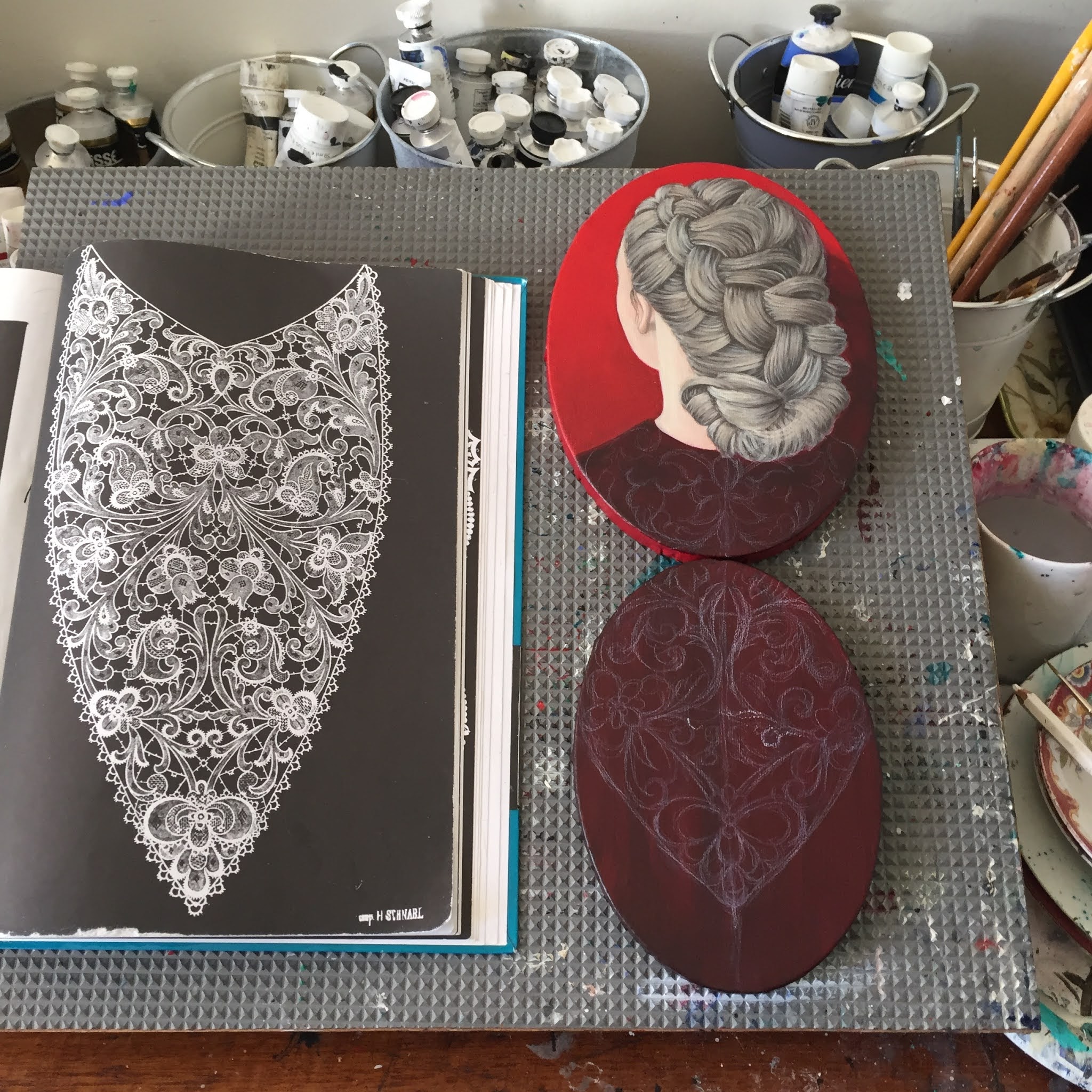
My protagonist’s intricately-patterned lace shawl is based on the even more complex design reproduced in the first image below, a panel of Austrian lace dating from the 19th century. As with all of the lace depicted in my work, rather than making a straight copy, which frankly I’d find extremely tedious, I select elements of a pattern, rearranging and adapting these to fit the format of the image. Until the pattern is resolved and each component has found its place, a watercolour pencil (white works best on a dark background) is a useful tool. Needless to add, a very fine brush is essential.

The well-thumbed reference book is Lace, L’Aventurine, Paris, 1995. English edition: Bookking International, Paris, 1995, English translation by Sue Budden.

A series of progress views follow directly.


Tuesday, February 2, 2021

Anonymous Woman with a Lace Collar


Pictured above: recently completed Anonymous Woman with a Lace Collar, acrylic on canvas, diptych, 35 x 12.5 cm. (See also previous blog post, Tuesday, January 26).

As previously mentioned, Hans Holbein the Younger (c. 1497 - 1543) has long been one of my favourite artists and three of his works, Portrait of a Lady with a Squirrel and a Starling (collection National Gallery, London) Portrait of a Young Woman (collection Mauritshuis, Den Haag), reproduced below as postcards collected from past travels, followed by Christina of Denmark (collection National Gallery, London) were very much in my mind’s eye when I made this work.

My partner, Shane Jones, shares my admiration for Holbein. We were extremely fortunate that our visit to London in 2006 coincided with Holbein in England, an extensive retrospective at Tate Britain. A room guide of the exhibition is HERE. 

Some years ago, when my latest stay in London was coming to an end, I had a few hours to spare before heading for the airport. My friends Sue Verney and Bev Murray asked me how I’d like to spend my precious remaining time. Without hesitation, my request was to call into the National Gallery and revisit Holbein’s Portrait of a Lady with a Squirrel and a Starling and Christina of Denmark one last time.

Some of Shane’s and my greatest pleasures during lockdown were the films and illustrated lectures presented by the National Gallery’s YouTube channel, which we were able to project onto our home cinema screen. Their channel, which is highly recommended, is HERE.

For an illustrated talk on Christina of Denmark by Susan Foister, Deputy Director and Director of Collections at the National Gallery, go HERE.

The National Gallery is also home to one of Holbein’s most celebrated masterworks, The Ambassadors. Susan Foister discusses the work HERE.

How I miss London and its museums, which over many years have provided infinitely rich and varied sources of inspiration for my work. There is no substitute for seeing artworks and one’s friends in the flesh, but thanks to YouTube and regular phone conversations via WhatsApp with Bev, Sue and another steadfast and inspirational London-based friend, Barbara Britton, at least it feels as if the distance between us has shrunk a little. 


A series of developmental views of Anonymous Woman with a Lace Collar follows. The most significant difference between the final image and the finished work, top, is the suggestion of volume in the bottom panel through the slight sheen in the subject’s garment (not entirely clear in my photo). The textbook on lace in the second view below, a gift from Bev, has been an invaluable reference for this series. I’ll talk more about my sources for the lace imagery in a future post.


Tuesday, January 26, 2021

Under her eye

Under the steely gaze of Alice, life in the studio continues at a measured pace. The photos above and below were taken roughly a fortnight apart, as the increasingly crowded bench top attests. When not in use for printmaking, the worktop frequently overlooked by beady-eyed Alice doubles as a repository for current paintings in various stages of progress. In the final photo below, I’ve singled out one of them. Initially the work was intended to comprise a single panel, but after some consideration, it was extended into a diptych. My next post will focus on key stages of its subsequent development.

A favourite painter of mine is Hans Holbein the Younger and the palette of this work, notably the blue-green background, was influenced by three of his works I particularly admire. Postcards of two of them, Portrait of a Lady with a Squirrel and a Starling and Portrait of a Young Woman, collected during the years we could still travel, are propped up on the drawers to the right of Alice’s lookout. These portraits and Christina of Denmark, the third of Holbein’s works I’ve lately revisited, if only from a distance, will be discussed in more detail in my following post. Click on individual images for a clearer view.


Saturday, November 7, 2020

Rückenfigur

Deborah Klein, current work in progress, a triptych as yet untitled.
Acrylic on linen, 40.5 x 30.5 cm (each panel).


I have to stay alone in order to fully contemplate and feel nature. The painter should paint not only what he has in front of him, but also what he sees inside himself.

- Caspar David Friedrich


Recently I discovered by sheer chance that the dominant motif in my work for well over two decades has a name. It’s “Rückenfigur”, or “figure seen from the back”. Why did I not know this before? The subject dates from antiquity, but the term originated in the German Romantic Movement of the 19th century and is most closely associated with the painter Caspar David Friedrich, whose work I’ve long admired. In fact, his paintings were the main catalyst for my current body of work, a series of anonymous figures I call “Journeywomen”.


Caspar David Friedrich, Wanderer above the Sea of Fog, 1818.
Oil on canvas, 94.8 x 74.8 cm, Kunsthalle Hamburg.


The history of figures viewed from behind spans the entirety of visual culture, including graphics, cinema and photography. Among the painters who have employed the Rückenfigur in their works are Rene Magritte, Man Ray, Salvador Dali, Gustave Courbet, Jean-Auguste-Dominique Ingres and, most notably and consistently, another of my favourite artists, Vilhelm Hammershøi.


Vilhelm Hammershoi, Interior with Young Woman Seen from the Back, 1904.
 Oil on canvas, 60.5 x 50.5 cm, Randers Museum of Art.


The Rückenfigur is often portrayed as an outsider, reflecting a mood of quietude, self-containment and isolation, although she doesn’t necessarily travel alone. Paradoxically, she invites us to share her journey and see the world through her eyes, to the extent that we almost become her.

What's in a name? That which we call a rose

By any other name would smell as sweet.

- William Shakespeare, Romeo and Juliet, ca 1597.


I’m fairly well versed in the ever-evolving history of  “rear view portraits,” yet this feels like a real light bulb moment. I am amazed at how empowering it is to to know that there is a collective name for them. To my mind, it validates and unifies this somewhat scattered tradition. Moreover, the Rückenfigur addresses a particularly divisive time in our history, when our state of disconnection - from ourselves, from each other and from the natural world - seems greater than ever before. 


Only connect! That was her whole sermon. Only connect the prose and the passion, and both will be exalted, and human love will be seen at its height. Live in fragments no longer. Only connect, and the beast and the monk, robbed of the isolation that is life to either, will die.

– E. M. Forster, Howards End, 1910.


Photo credit for above image: Shane Jones.