Pages


Showing posts with label The Pirate Jenny Prints. Show all posts

Thursday, September 12, 2024

Early linocuts at Gippsland Art Gallery

Many thanks to Lesley Duxbury for these photos of two of my early linocuts, currently on exhibit at Gippsland Art Gallery, Sale, one of my favourite regional galleries.

Pictured top: Sometimes Jenny took long and lonely walks along the long and lonely beach, 1988, from the Pirate Jenny Prints suite of linocuts (1987-88). The point of departure for the work was the titular character in The Threepenny Opera, a jazz-influenced opera by Bertolt Brecht (book and lyrics) and Kurt Weill (music). It premiered at Theater am Schiffbauerdamm in Berlin in 1928. Ostensibly set in Victorian London, the opera is a savage satire of Germany’s Weimar Republic. In this series, I took Jenny out of London/Berlin and placed her in the red light district of my home town, St Kilda. (It has been done since, in 2010, as a theatre production with the great Paul Capsis as Pirate Jenny, but as far as I know, I was the first to do it)! 

Most of the works in the Pirate Jenny suite owe a debt to German Expressionism, in the case of this work, the German Expressionist film The Cabinet of Doctor Caligari, 1920, (Dir. Robert Wiene). 


The second linocut, the absurdist A Man, a Woman and a Duck, 1996, also set on St Kilda beach, is a more playful and affectionate homage to my home town. (Image 2, second from top).

Second view, top: Susan Fraser, One, two, slide, Back, two, slide, 2013, linocut. 

All works: Collection Gippsland Art Gallery, Sale.

I understand the works will be on view for three months.

Monday, March 27, 2023

Clunes Booktown 2023

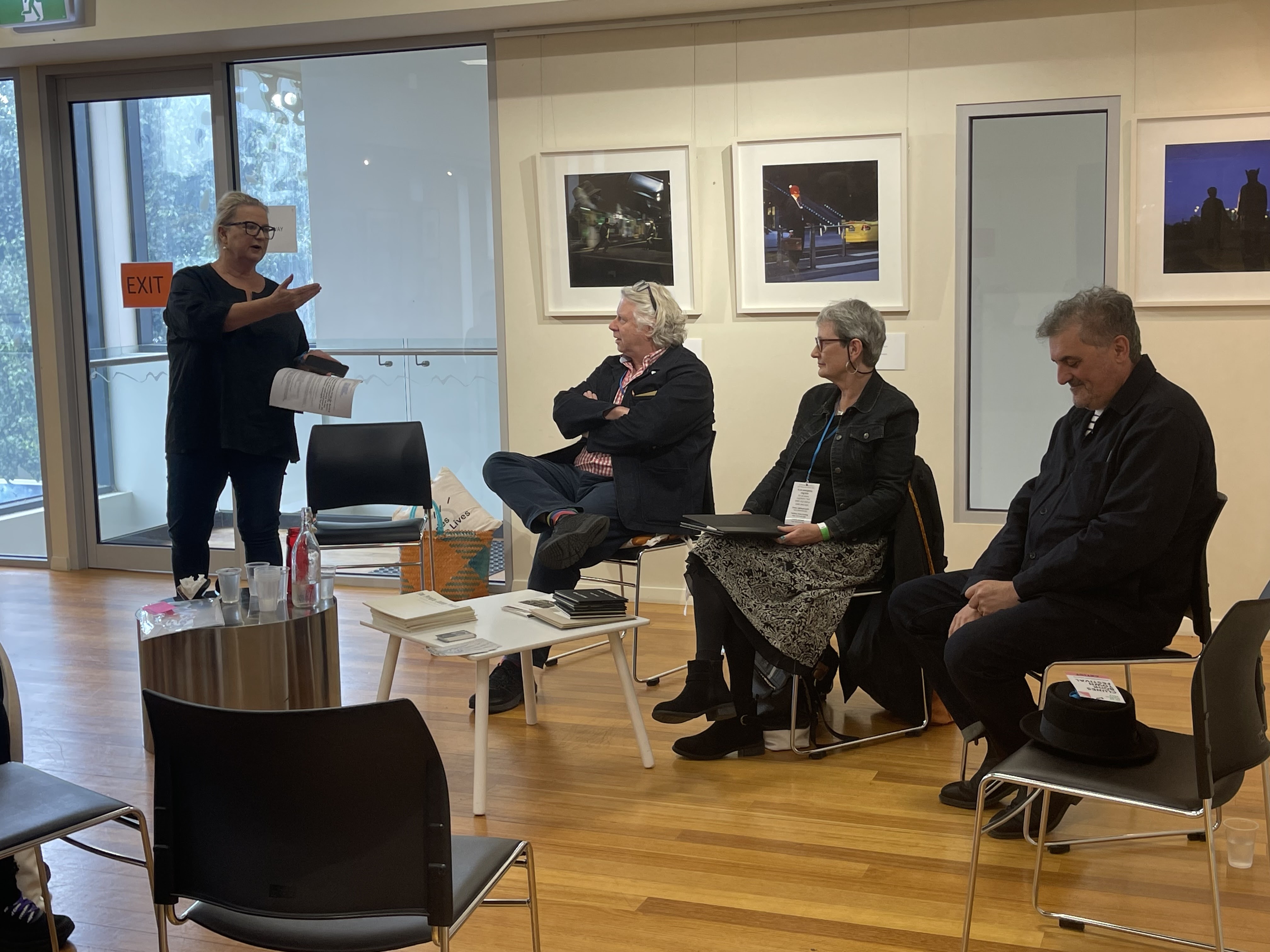
Pictured above and below: a handful of photos snapped at yesterday afternoon’s panel discussion Not Just a Pretty Picture in the Esmond Gallery at Clunes Booktown. 

A big thank you to everyone involved in the organisation of Clunes Booktown Festival 2023, especially Jon Hawkes and Sue Beal, who invited me to join the dream team of panelists, Simon Perry and Philip Faulks, to our wonderful Chair, Michele Ely, and to Shelley Hinton, who hung the accompanying exhibition, A picture’s worth a thousand words.

Thanks also to everyone who came to our talk. It was lovely seeing so many of you there. We couldn’t have wished for a more terrific audience. I hope you had as much fun as we did. 


Photos 1 & 2, L-R: Chair Michele Ely, panelists Simon Perry, myself and Philip Faulks; 
Photo 3: Discussing my painting ‘Apiary’, 2022;
Photo 4, L-R: Linocuts by DK and drawings by Philip Faulks;
Photo 5, L-R: My linocuts The Heavens Declare 1 & 2, 2022 and Pirate Jenny and Mack the Knife and Pirate Jenny in a Kimono, both 1987.

Friday, March 24, 2023

A thousand words at Clunes Booktown


On Sunday afternoon, March 26, I will join forces with artists Philip Faulks, Simon Perry, Darcy McConnell (ENOKi) and Chairperson Michele Ely in the Esmond Gallery at the renowned Clunes Booktown Festival for what we trust will be a lively and enlightening panel discussion about the stories we tell through our artworks. 


Accompanying the talk is an exhibition curated by Shelley Hinton: A picture’s worth a thousand words. I have four linocuts in the show, including two early works, Pirate Jenny in a Kimono and Pirate Jenny and Mack the Knife, from the seminal Pirate Jenny Suite, the first of my works to employ narrative.

📖Not just a pretty picture

🗓Sunday 26 March, 1.00pm

📍Esmond Gallery, Clunes 

🎫 https://tickets.clunesbooktown.com.au/Events/Not-just-a-pretty-picture


Pictured from top:

1: Pirate Jenny in a Kimono, 1987, linocut 61.5 x 46 cm. (Private collection)

2: Pirate Jenny and Mack the Knife, 1987, linocut, 61.5 x 45.5 cm. (Private collection)

Saturday, January 7, 2012

The Ghost of Artworks Past

Many moons ago, when my work was hovering uncertainly at a major crossroads, my Postgraduate Supervisor Euan Heng was both encouraging and perceptive. At this stage the new ideas were still mainly in my head; he also cautioned me that if I didn’t bring off what would be a radical change of direction, "Old work can come back to haunt you". For one who frequently suffers the torments of hell when an old work is exhumed, his warning hit home. But I knew I’d come as far as I could with the current imagery. I believed in my new ideas and change was inevitable, no matter what misgivings I might also have.

In fact what eventuated, namely the Pirate Jenny Prints suite of linocuts (1987) became a significant turning point, setting me on the path that, aside from the odd detour (and inevitable dead end) I tread with varying degrees of assurance to this day. I’m still rather proud of them.

 Pirate Jenny at Luna Park, 1987

 Pirate Jenny and Mack the Knife, 1987

Pirate Jenny in a Kimono, 1987

Admittedly there are other instances when I don’t feel like crawling under the covers when the Ghost of Artworks Past pays an unsolicited call. But occasionally I’m confronted with some abomination that in some cases would have been better off being humanely destroyed.  I see nothing but glaring imperfections and think how much better the work would be had I made it today.

When I became a Master of Arts candidate in 1995 (once again under Euan Heng’s judicious supervision) my drawing style changed markedly. It was undoubtedly directed by my thesis, namely women in Film Noir and the Woman’s Picture. By mid 1996 the work had become less mannered and stylized as I gradually moved away from previous influences, including German Expressionism. As a result, it is mainly (although not exclusively) the pre-Film Noir and some early works from the series that have, for me at least, ‘dated’ and which have caused me the most grief. But I think it’s also fair to say that rather than existing solely as eternal testaments to my ineptitude, a few of these works have their good points, whether it’s the ideas behind them, or even isolated areas of technical competence.


Above left: 4 The Letter, 1995
Above right: 5 Mildred Pierce on St. Kilda Pier, 1995

A selection of my old pictures, including several from that vexed pre-1996 period, now grace the walls of the house at Ballarat, thus creating some sorely needed space in our storage area in Melbourne. Some deserved to once again see the light of day far more than others, and these were hung soon after we moved in. But those I felt more ambivalent about remained stacked against a wall for nearly a year.  We finally hung them over the Christmas break. Several are in my studio. We are gradually learning to coexist and I realize that I might actually be able to learn something from them. It's starting to feel like it could be a positive place from which to begin a new year and a new body of work.

 6 Studio view, January 2012

7 Studio view 2, January 2012
Pictured above (from top):

1 Pirate Jenny at Luna Park, 1987, linocut, 61.5 x 45.5 cm
2 Pirate Jenny and Mack the Knife, 1987, linocut, 61.5 x 45.5 cm
3 Pirate Jenny in a Kimono, 1987, linocut 61.5 x 46 cm
Pirate Jenny is a character in The Threepenny Opera, by Kurt Weill (music) and Bertolt Brecht (book and lyrics). Ostensibly set in London, its spiritual home was Berlin, where it premiered in 1928. I transplanted its original location to scruffy, pre-gentrified St. Kilda in Melbourne, where I was then living and working. The Pirate Jenny Prints were published by Port Jackson Press, Melbourne and subsequently toured nationally. Euan Heng wrote the introduction to the catalogue that accompanied the tour.

4 and 5 (see below)

6 Studio view, Ballarat, January 2012
Pictures from left:

Untitled, (c 1994) oil pastel, 76 x 56 cm
Unlike most of my work, this image is not connected to a thematically linked series.  This sad but spirited wallflower was inspired by a poignant group of photographs from the 1950s, taken at a high school dance when American film legend James Dean paid a return visit to the small town where he was raised.

Mildred Pierce on St. Kilda Pier*, 1995, oil on canvas, 61 x 51 cm
The Letter, 1995, oil on canvas, 61 x 51 cm
These are linked to the Film Noir series of the mid 90s. They are two of the few surviving paintings from that period. As the series progressed, I found that the nocturnal world of film noir was best served by the linocut medium. In fact both images were subsequently developed into linocuts. They were included, along with the linocuts, in my second solo exhibition at Australian Galleries, Melbourne, in 1996. (*For more on Mildred Pierce, see Blog Post February 12, 2011.)

The Red Dress and the White Dress, 1992, oil pastel, 74.5 x 54.5 cm
This drawing takes its points of departure from two of Dorothy Parker’s poems. It was originally part of a 1992 solo exhibition, my first at Australian Galleries in Melbourne. The exhibition focused on the lives and work of writers Dorothy Parker, Zelda Fitzgerald and Virginia Woolf. The series was also exhibited at Solander Gallery in Canberra.

7 Studio View 2, January 2012
Pictures from left:

Snake Charmer, 1996, linocut, 36 x 37.5 cm
Fairgrounds and circuses often feature in Film Noir. This is one work I’ve always had a certain fondness for.

Night Drivers, 1996, oil pastel, 55 x 75 cm
The danger inherent when anyone gets behind of the wheel of a car was exploited regularly in Film Noir. When researching this work, I derived particular inspiration from the superb Nicholas Ray film In a Lonely Place (1950) and the Bette Davis camp classic Beyond the Forest (dir. King Vidor, 1949, in which she utters the celebrated line, long beloved by Davis impersonators, "What a Dump!") This drawing was transposed into a linocut, which in my opinion worked much better.  Both versions also debuted at Australian Galleries, Melbourne in 1996.

Friday, July 22, 2011

Looking back to see...


Looking back to see... 2011, linocut with chine colle, 38 x 28 cm

Here is a preview of my most recent print, made especially for Familiar/Unfamiliar, curated by Rona Green. The project was initiated by the Print Council of Australia to celebrate its 45th anniversary. The exhibition, comprising 45 printmakers, will be held in conjunction with IMPACT 7, the International Printmaking conference to be hosted by Monash University in late September.

Looking back to see… is a personal response to Familiar/Unfamilar's central brief, namely to explore perspectives on people and place. It is essentially about looking back across time from one place with which I was once familiar towards another to which I was equally, if not more, attached, namely the St. Kilda of my childhood and adolescence, and London, where I lived for several years in the 1970s. Many people look upon the 70s with disdain, but that time in London was seminal for me both personally and as a fledgling artist. As we know, familiarity can also breed contempt; by comparison, my feelings towards St. Kilda are more ambivalent. But both places profoundly affected my life and work.

I first crossed paths with the black and white cat and during my first year in London. It was a blessed, predestined alliance that would last many years - for the rest of her life, in fact. She is another kind of familiar, usually associated with witches. In the 1980s Mimi came to live in Australia with me, initially in St. Kilda. She is both a vital link between the two cities and the first and best loved of all the memorable cats that have shared my life.

Most of the drawing for Looking back to see… was developed in June 2011, during a residency at the Art Vault in Mildura. Being geographically removed and in neutral territory gave me a clearer perspective on the recollections that led me to this point in time.

Work in progress at the Art Vault and some reference material, June 2011

As I mined my memories, I was also incited to revisit past imagery, iconography and printmaking techniques. This is the first work for many years to incorporate a background. Mimi appeared in several of my linocuts of the 1980s, including some of the first I ever made. The steamer and the Westgate Bridge on the horizon line, both personal symbols of escape, were appropriated from my linocut St. Kilda Warrior (1996). The Westgate Bridge also appeared in an earlier linocut Sometimes Jenny Took Long and Lonely Walks Along the Long and Lonely Beach (1987.) The arts and crafts movement-inspired rose is another emblem that has featured many times in my work. It is incorporated here, also not for the first time, in the form of a tattoo. (An early example is Rose Tattoos, 1995.) The rich crimson of the rose and hair ribbon were applied via chine colle, a collage-based technique that I haven’t used in many years.

She is not amused, 1987, linocut on Japanese
paper, 75 x 53 cm

St Kilda Warrior, 1996, linocut, 61.2 x 45.3 cm

Sometimes Jenny Took Long and Lonely Walks Along
the Long and Lonely Beach, 1987, 61.5 x 45.5 cm
(from The Pirate Jenny Prints, 1986-87)

Rose Tattoos, 1995, linocut, hand coloured,
46 x 30 cm (from the Tattooed Faces and Figures
series, 1995-1997)

Ironically, given that I am based in Australia, I tend to revisit London more often than I do St Kilda. Not surprisingly, both places contain elements of the familiar and unfamiliar. Like all cities they are only impervious to change when carefully preserved in our memories.

Pictured below are selected stages in the development of Looking back to see...


Two of many developmental sketches

Lino block in progress, with tattoos still to be resolved

Final stage of drawing on lino block ready for cutting

Proofing at Ballarat. It was only at this stage 
 that I noticed the picture directly outside,
an early portrait of Mimi (see below)

Cat on a Mat, 1986, linocut

Bon a tirer without chine colle


Familiar/Unfamiliar will be exhibited from 28 September - 16 October at

c3 contemporary artspace 
The Abbotstford Convent
1 St. Heliers Street
Abbotsford Vic

It will tour to Tweed River Regional Art Gallery, NSW from 11 May - 24 June, 2012 and Swan Hill Regional Gallery in 2013 - dates to be confirmed. I will post full details, including a list of exhibiting artists, nearer the time of the exhibition's launch in September.