Pages


Showing posts with label Insects. Show all posts

Wednesday, June 1, 2022

Insects in art


Pictured above: progress views of my current work, Apiary, snapped in my Ballarat studio shortly before its move to the residency studio at Geelong Grammar School. 


Directly below is the work that inspired it. Portrait of a Woman of the Hofer Family, c. 1470, by an unidentified Swabian artist, is a painting that has intrigued me ever since I happened upon it in the National Gallery, London, in 1993. 


At the time the work was made, Swabia included parts of Southern Germany, Switzerland and France. The artist is unknown, as is the identity of the sitter, although we can still discern something of her background. Her jewellery and opulent costume indicate wealth and the text in the top left hand corner, "Geborne Hoferin," translates as "born a Hofer." 


The fly that has apparently landed on the sitter’s otherwise immaculate headdress is a striking  example of trompe-l'œil (French for “deceives the eye”). It lends a decidedly unsettling element to what would otherwise have been a charming, but conventional portrait. In art, flies have long served as symbols of mortality. Nevertheless, the painted insect could be regarded as nothing more than a visual joke, intended solely to trick us into believing a fly has actually landed on the painting. When viewed in combination with the sprig of Forget-Me-Nots held by the sitter, however, the work seems more likely to be a posthumous portrait, commissioned by wealthy patrons in remembrance of the sitter.


Shortly after first discovering the work, I began an Australia Council residency at the Cite International des Arts in Paris. During my three month stay, I made two works in homage to Portrait of a Woman of the Hofer Family, a small linocut, followed by a more detailed oil pastel drawing. From memory, it was fairly close in scale to the painting on which it was based. I included most of the original compositional elements, with one notable exception. In order to personalise the work, I replaced the fly with a bee, a symbol of more personal significance. Deborah is elicited from D'vorah, a Hebrew a word meaning "bee", the symbol of prophecy in Ancient Greece. When combined with the sprig of Forget-Me-Nots, the print and drawing became personal expressions of homesickness. 


Apiary recalls this painting, evoking a similar era and reinstating the bee emblem. It’s a particularly personal work, albeit in an entirely different context, and I was at pains to paint the bee as convincingly as possible. Only after I’d finished, did I realise the bee is slightly too large in scale.


Lately I’ve had some lively conversations with staff and students during my residency at Geelong Grammar School, where I’ve been making the finishing touches to the work. Chris, a staff member who is also a bee keeper, admired my bee, which was somewhat heartening. When I expressed my concerns that the bee was a little oversized, he replied, “Well, it’s your bee!’ And so it is - so it shall stay just as it is. Thank you, Chris!


On the following day, I was discussing Apiary and its influences, including Portrait of a Woman of the Hofer Family, with a group of students. In an uncanny instance of life imitating art, a fly landed on the subject’s painted headdress, right next to my bee. Unfortunately I wasn’t able to whip out my camera quickly enough before the fly moved on to explore other areas of the canvas. You can just spot it nestled in the darker folds of the painted fabric.

Saturday, November 9, 2019

Harlequin bug tattoo

On the work table: Harlequin bug tattoo, pigmented drawing ink and gouache on Khadi paper, 21 x 15 cm

Following directly from my previous post, Harlequin bug tattoo is another work begun in my hotel room in August during the 2019 Melbourne International Film Festival (see below). The drawing, pictured above, was completed after my return to Ballarat. Scroll down further for selected progress views and to meet a real Harlequin bug.


The insect tattoo is modelled on the species Dindymus versicolor, commonly called Harlequin bugs, that regularly visit my studio in the back garden of the house we'll soon be leaving.


It’s a very pretty insect, but don’t let appearances fool you. Dindymus versicolor is regarded as a pest, reportedly attacking cotton, kurrajong, vegetables, pome fruits, stone fruits, grapes, figs, strawberries, violets, wisteria and dahlias. I don’t like to throw accusations without proof, but think I’ve finally figured out what has been devouring our strawberries all these years. Despite all that, I'm going to miss the Harlequin bugs and my beautiful studio.

Thursday, April 14, 2016

Frog-legged Leaf Beetle Woman

According to the Book of Beetles (edited by Patrice Bouchard, Ivy Press, Great Britain, 2014) the Frog-legged Leaf Beetle (sagra buqueti) from which this newly-discovered homo-insecta evolved is one of the world’s largest, most colourful leaf beetles. Despite its considerable size (20-39 mm) and distinctive appearance, little is known about the beetle in the wild. However, other equally colourful and sizeable species of the genus Sagra can be found on climbing vines in the jungles of Asia. (See image second from top). The remaining images in this post are progress views of my recently completed unnatural history illustration of the Frog-legged Beetle Woman, culminating with the finished work. 


Completed Frog-legged Leaf Beetle Woman, 2016, watercolour, 41.91 x 29.72 cm

Sunday, November 29, 2015

Splendid emerald Wasp Woman


Pictured above: the recently completed (and aptly named) Splendid emerald Wasp Woman, 2015, watercolour, 41.91 x 29.72 cm, followed by a short sequence of developmental views.


Monday, November 23, 2015

Castiarina sagittaria Beetle Woman


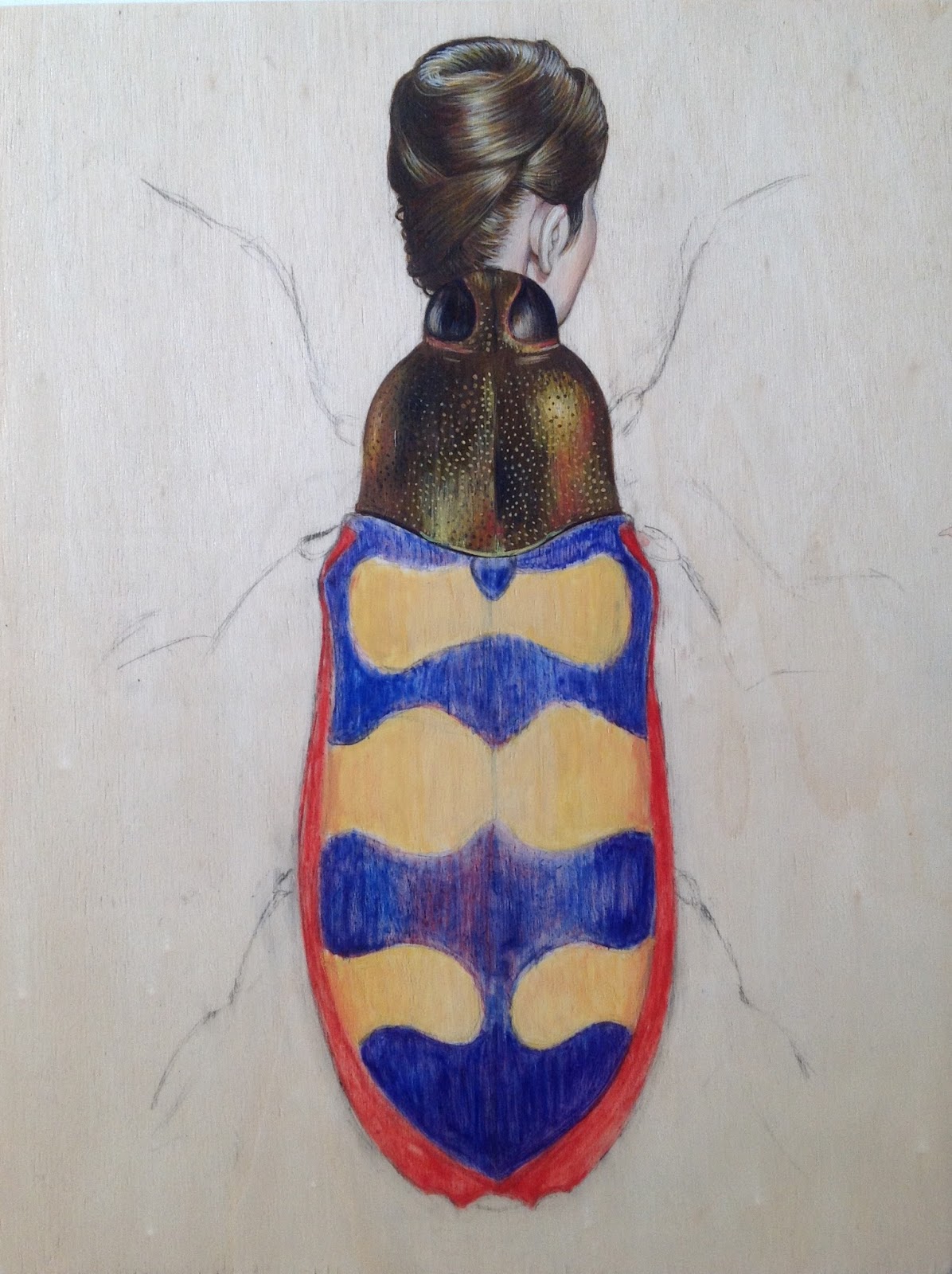
Appearing here for the very first time is Castiarina sagittaria Beetle Woman, a newly discovered Homo-insecta that was recently documented in the Ballarat studio. The Castiarina sagittaria jewel beetle from which she evolved (pictured in the final image below) hails from this part of the world, namely south western Victoria.

The completed painting, Castiarina Sagittaria Beetle Woman (2015, acrylic on wood, 32 x 30 cm) is shown above. Directly below are a series of progress views of the work:


Thursday, September 24, 2015

A Trip to Hobart, Part Five: A Hobart Miscellany and Last Orders

After checking into our hotel on the first day in Hobart, Shane and I went for a walk to get our bearings. An exploration of nearby Victoria Docks proved to be extremely fruitful. We bought advance tickets for MONA (see Blog Post Tuesday, September 22) and also discovered the Bruny Island Tours booking office, where we decided to book passages on the cruise that was documented in my previous post.

Shane studies The Bernacchi Tribute - Self Portrait, Louis and Joe (detail) at Victoria Docks. See also plaque below.


The Tasmanian Museum and Art Gallery from Victoria Docks

Gratified that our trip was already starting to take shape, we stopped for a drink at the Hope and Anchor, directly opposite the docks. Its name seemed to be a positive omen. (Regular visitors to this blog may remember that an anchor tattoo is the leitmotif of Inking Up, the current exhibition at Castlemaine Gallery and Historical Museum, that I have some works in). As it happened, we discovered yet another connection with tattoos. We got talking to the young barmaid, who told us that she and her boyfriend had first called into the pub late one night some months back, after other hotels had refused to serve them because of his tattoos. She fell in love with the upstairs rooms, which she likened to a museum. In fact, she was so impressed with the pub and its friendly landlords, she asked for a job there. On her advice, we climbed the stairs and were similarly enchanted by the eccentric, eclectic collection, which was spread over several rooms.

The Hope and Anchor 

Above and directly below: upstairs rooms at the Hope and Anchor


I’ve never associated Art deco architecture with Hobart, but we discovered some striking examples in our immediate area:

Colonial Mutual Life Building

Headquarters of the Mercury Newspaper

The T & G Building is minutes away from Hadley's Orient Hotel, where we were based

It’s always hard to relax during the last day in another town, especially if you have a plane to catch. We were fortunate that our final day was also market day (as mentioned in Part 1 of this five-part series, Salamanca Market was a short walk from our hotel). It was a perfect way of whiling away a few hours. 

We called into Colville Street Gallery and had a coffee in the gorgeous little café outside the Peacock Theatre before taking on the market. 

Shane at Salamanca Market, Saturday, September 12


Some seriously talented makers (and, as shown above, others who are not quite so serious) sell their wares at Salamanca Market; it is every bit as colourful and lively as we remembered it. Better still, we found a stall selling insect specimens, where I discovered an absolute treasure - the exquisite leaf insect pictured below. I’ve been searching for one of these for a long time. On the rare occasions I have come across examples in Melbourne, they are always prohibitively expensive.

Leaf insect - a lucky find at a Salamanca Market stall

With some time still up our sleeves, we decided to end our trip much as we’d begun it, with a drink at the Hope and Anchor. Here’s to you, Hobart, and to our speedy return.

Above and directly below: last orders at the Hope and Anchor