Pages


Showing posts with label Lepidoptera. Show all posts

Sunday, April 19, 2020

COVERT COVID


In the latest instalment of its long, complex history, the mask has become emblematic of these troubled times. It seems the moth masks I created several years ago have finally come into their own. A spontaneous photograph, snapped during a recent studio clear up, has inadvertently spawned an ongoing series, COVERT COVID, a personal response to social distancing and life in lockdown.

Pictured top: Covert Covid 1: Self-portrait in Anaxidia lactea Moth Mask. (1)

The artist's studio, Ballarat East, Sunday, 19 April 2020.

(1) Anaxidia lactea mask, 2010, acrylic on found papier-mâché mask.

Thursday, October 6, 2016

CREATURES


I'm delighted to have had three of my works curated into CREATURES, the exhibition officially opening next Sunday at Queenscliff Gallery & Workshop. Judging by the lineup of artists, it should be a terrific show. 

Exhibiting artists: Kaitlin Beckett, Aileen Brown, Michelle Joy Caithness, Paul Compton, Deborah Klein, Leonie Connellan, Tony Convey, Gordon Craig, Philip Davey, Jole Di Florio, Silvi Glattauer, Rona Green, Callum Jackson, Julie Mia Holmes, Ying Huang, Hyun Ju Kim, Damon Kowarsky, Olivia Mazzone, Graeme Peebles, Catherine Pilgrim, Geoffrey Ricardo, John Ryrie, Lisa Sewards, Spook, Susan Wald, Emilie Walsh, Andrew Weatherill, Deborah Williams, Joel Wolter, and Tin Wong.

Official Opening: Sunday, 9 October, at 3pm

The exhibition runs from October 5 - 31

Queenscliff Gallery & Workshop 
81 Hesse Street 
Queenscliff 3225 

Phone: 03 5258 4927


Gallery hours: 10 - 5 daily. (Closed on Tuesday)

My own contributions to CREATURES, three linocuts from the Winged Women series, are directly below:


Blue Tiger Winged Woman, 2010, linocut, 34 x 34 cm. Ed 30 


Great Eggfly Winged Woman, 2010, linocut, 34 x 34 cm. Ed. 30


Macleay's Swallowtail Winged Woman, 2010, linocut, 34 x 34 cm. Ed. 30

Saturday, August 27, 2016

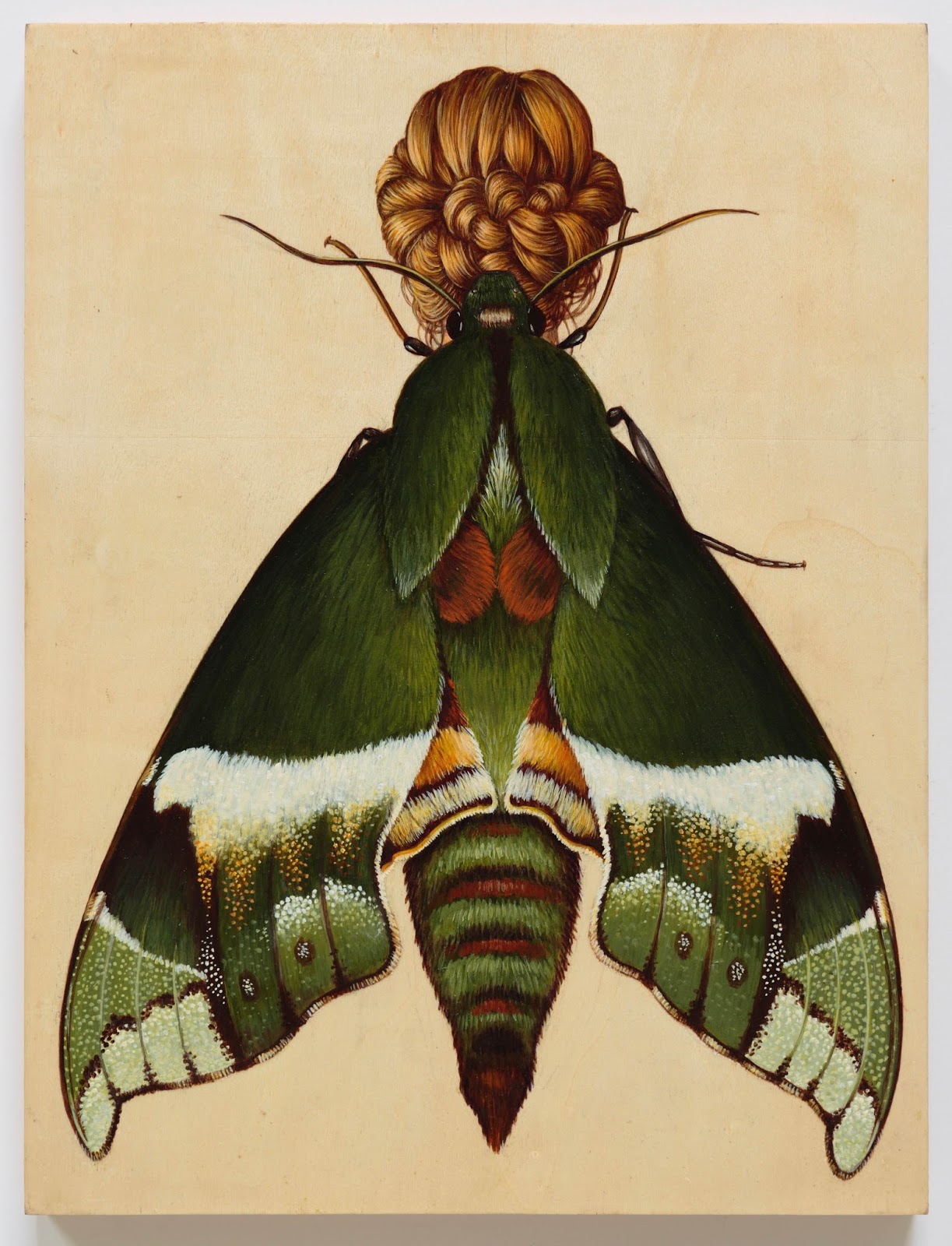
Hawk Moth Woman

Hawk Moth Woman, 2016, acrylic on wood panel 32 x 30 cm. Photo credit: Tim Gresham

In Australia there are approximately 65 hawk moth species. Mostly found in the tropics, they are the only family of the Sphingidae.

Newly documented, Hawk Moth Woman (pictured top) is the latest link in the evolutionary chain of Angonyx papuana (pictured directly below). The Homo-insecta has inherited her insect forbear's superb aerodynamic shape; not surprisingly, she is a remarkably swift and powerful flyer.

Hawk moth, Angonyx papuana, Sphingidae. From A Field Guide to Insects in Australia
(Third Edition). Paul Zborowski and Ross Storey, Reed New Holland, 2010

To learn more about this moth woman’s lepidopteran relatives, go HERE.

Selected stages in the documentation process of Hawk Moth Woman are directly below.


Hawk Moth Woman freshly completed, with the paint on her wings barely dried

Tuesday, September 22, 2015

A Trip to Hobart, Part 3: the Tasmanian Museum and Art Gallery

Shane at the entrance to the Tasmanian Museum and Art Gallery

We were incredibly fortunate with the weather during our brief stay in Hobart. The one day it rained with any serious intent was a museum day. Shane's facial expression says it all. As he literally walks on water, he is clearly willing me to take this shot before the next downpour. 

The Tasmanian Museum and Art Gallery has undergone extensive renovation since our last trip to Hobart in 2002. It’s a brilliant museum with a fantastic collection, including a veritable treasure trove of potential reference material for my own work.

This post features a mere fraction of the museum's gems.

Just inside the entrance are a selection of fittings, furniture and relics from Palfreyman’s Pharmacy (1860-1961). To read about its history, click on the image below:


Pictured below is the museum's Central Gallery, viewed from the upper level:


My imagination was caught by these garlands of beetles, displayed on interior windows on the ground floor level of the Central Gallery:


A room devoted to the long-extinct thylacine (once more commonly known as the Tasmanian Tiger) lent a poignant note to our visit:


I’ve transcribed the following from the label that accompanied the short film of the last survivor of the species: 

A sad history

As the largest carnivorous mammal in Van Diemen’s Land, the thylacine was persecuted and killed by graziers, who saw the animals as a threat to their flocks.

The Van Diemen’s Land Company offered a thylacine reward and even employed a ‘tiger man’ to hunt them. Agricultural societies also offered rewards, such as the Buckland and Spring Bay Tiger and Eagle Extermination Society in 1884. Several animals came to the museum from this society.


However most destructive of all was the Tasmanian Government legislation of 1888 targeting the thylacine. This established a bounty of one pound per adult and ten shillings per young. More than 2,000 payments were made between 1888 and 1909.

The last known thylacine died in the Hobart Zoo on 7 September 1836.


We missed this tragic anniversary by only a day; coincidentally, our visit to the museum was on 8 September.

Thankfully not extinct is the Tasmanian Woolf Spider. This view was taken through a magnifying glass:


The following two exhibits are displayed in the Bond Store, the section of the museum that focuses on 19th century Tasmania:

The insect collection of Thomas Judd

The notes below were copied out from the museum's label:

English schoolboy Thomas Judd arrived in Tasmania in 1842. He had always been interested in natural history and spent much of his time collecting, identifying, setting and pinning these specimens. Thomas’s family sold many of their belongings before moving to Tasmania, but Thomas brought this collection with him. He had made the case himself and it includes a secret compartment in the bottom drawer – no doubt to house his most treasured specimens. When rediscovered, the drawer held Thomas’s scientific notebook and some edelweiss that he had collected in Switzerland in 1898.

This remarkable example of a collection demonstrates the passion, time and effort that many untrained people put into recording and preserving nature.

The wax floral display by Eliza McMahon pictured below is somewhat unusual in that it includes Tasmanian native flora. (Australian flora wouldn’t be fully embraced in Australian art until the next century, most notably in the linocuts and paintings of Margaret Preston). Included in this arrangement are Christmas bells, a pandani flower, epacris, leucopogon, acacia, clematis and purple apple berry.


Eliza McMahon, Wax flower display (c.1890, wax, glass and wood)

Saturday, June 27, 2015

A Box of Beetles and a Line of Insect Women

A Box of Beetles was a recent lucky find in Horton Books, a favourite Melbourne bookstore. Located in Smith Street, Collingwood, it’s fairly local to our Melbourne place. Sadly, after 15 years in the area, Horton Books will close its doors in July. It’s a great shame to see the demise of another independent bookshop, particularly when it’s as special as this one.

Meanwhile, the diminutive treasure chest pictured below will provide me with rich and varied source material for a long time to come.

The Box of Beetles yields some of its treasures

As I research my next Homo-insecta works, here is the story so far, at least for the paintings on wood:

The first nine Homo-insecta paintings (acrylic on wood panels, 2015). Studio view, late June.