Pages


Showing posts with label National Gallery of Australia. Show all posts

Wednesday, May 29, 2019

BECOMING MODERN


As an art student, back in the 1980s, I largely taught myself to make linocuts from examples in books, and Roger Butler’s catalogue of the relief prints in the permanent collection of the Art Gallery of Ballarat (1) was my bible. So you can imagine my excitement about BECOMING MODERN - AUSTRALIAN WOMEN ARTISTS 1920 -1950, which opened last week. Not only does it include many key works by the women artists in my still treasured catalogue, but also numerous examples of paintings, prints, sculptures and by other much admired Modernists, most them from the AGB’s own collection. 

Superlatives all the way for BECOMING MODERN and congratulations and thanks to Curator Julie McLaren, AGB Director Louise Tegart, and all those involved in putting together this superb show. I can’t wait to add the exhibition catalogue to my collection. To learn more about the show, visit the Ballarat Courier HERE.

Last Friday’s memorable opening night, for which we were invited to dress in the Modernist mode, was impeccably stage managed by AGB Marketing and Public Programs Officer, Peter Freund. In the top photo, I’m pictured with Thea Proctor’s iconic hand coloured linocut, The Rose (1927). What a thrill it was to see it in the flesh. (Photo credit: Shane Jones). 

Directly below, I'm with Shane Jones and BECOMING MODERN curator Julie McLaren. (Photo credit: Peter Sparkman).
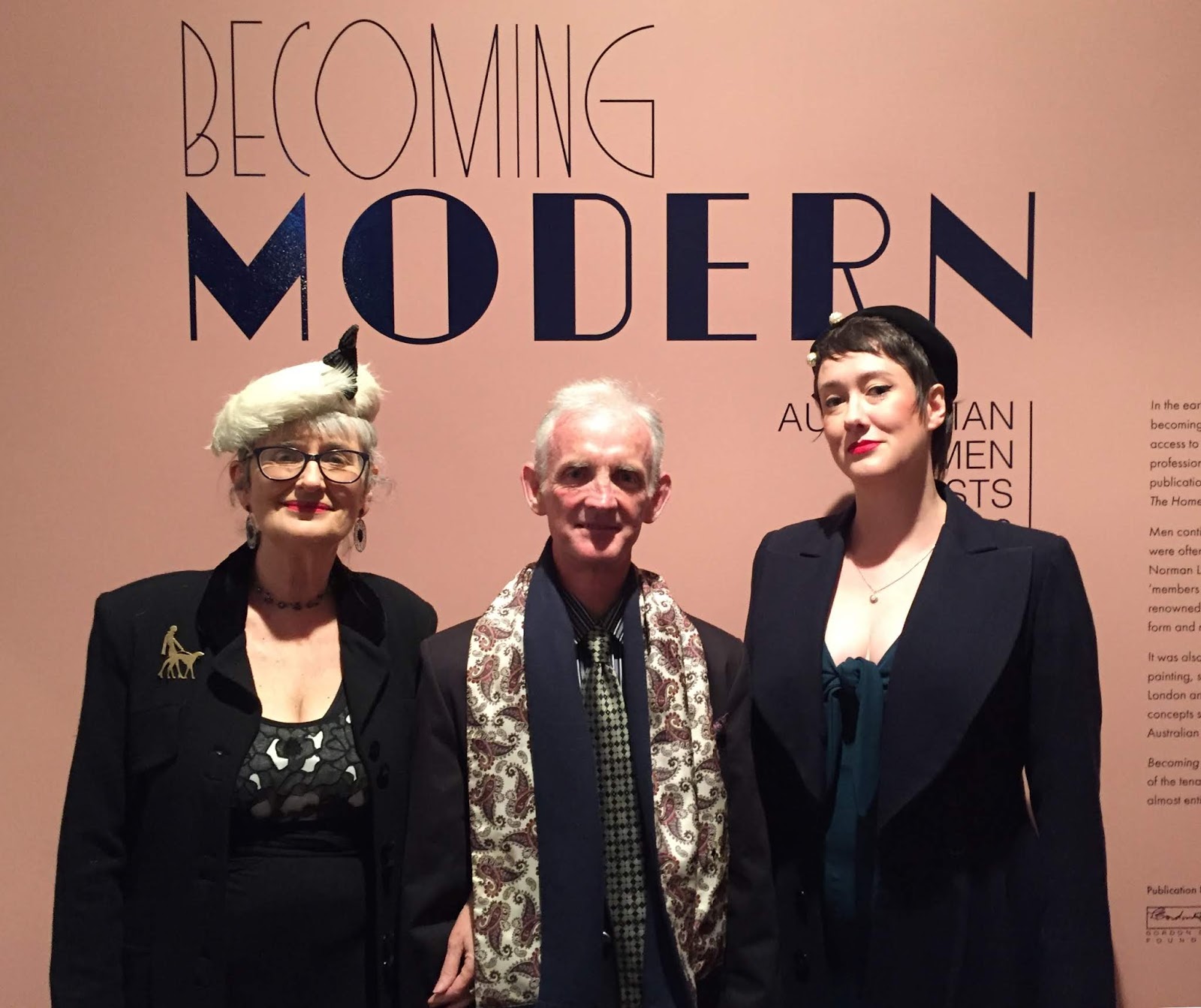

BECOMING MODERN runs to 4 August. 

The show is a timely one in terms of the campaign 24 Hour Project: Know My Name at the National Gallery of Australia, which was also launched on Friday night. The campaign's aim is to draw attention to the work of creative women everywhere. It will take a damn sight longer than 24 hours for that to happen, but it's a positive start. As Nick Mitzevich, Director, National Gallery of Australia, states:

"We want to do more than have a conversation about equality, we want to take action and address the significant imbalance before us... The value of women artists in this country needs to be elevated as we are a thriving, diverse culture that should be celebrated.”


(1) Roger Butler, 1981, Melbourne Woodcuts and Linocuts of the 1920s and 1930s, Ballarat Fine Art Gallery, Ballarat, Vic. 

Friday, April 8, 2016

A visit to Canberra, Part 2

Aside from its marvelous museums, my favourite thing about our capital city is the easy, graceful manner in which it cohabits with the natural world; perhaps more so than any major city I’ve ever visited.

The highlights of our daily walks along the banks of Lake Burley Griffin to and from the National Gallery of Australia, National Portrait Gallery and National Library of Australia were our encounters with some of the locals:

Shane in (top left photo) black swans, moor hens and ducks

A favourite haunt was the NGA Sculpture Garden, a haven of serenity: 

Auguste Rodin, Pierre de Wiessant, Eustache de Saint Pierre, Jean d'Aire and Andrieu d'Andres from
The burghers of Calais, 1985-86, cast 1967-84

One afternoon Shane and I stopped to admire two of Auguste Rodin’s nude studies for the Burghers of Calais, (c 1885-86, bronze, cast by Georges Rudier Foundry Paris, 1974).


Climbing the back of the lefthand figure at a rate of knots was this exquisite caterpillar:


Eagled-eyed Shane was the first to spot an extraordinary sight: a second caterpillar, semi-cocooned inside the mouth of the same figure. It’s a shame we won’t be around for its transformation into a butterfly and its maiden flight - an enchanting sight I’ll only ever get to see in my mind’s eye.


Foreground, centre: Emile Bourdelle, Penelope, 1912 with feathered visitor;
Background: Mark de Suvero, ik ook ('me too') 1971-72

Dadang Christanto, Heads from the North, 2004 (detail) See also image below
Background, centre: Henry Moore, Hill arches, 1973


Only one waterlily was in bloom, but it was a beauty 

Leaf litter

Burt Flugelman, Cones, 1982, stainless steel (detail)

Anthony Gormley, Angel of the North (life-size maquette), 1996, bronze


On the steps of the National Library of Australia (the statue of the monkey to my
left commemorates the Chinese Year of the Monkey). Photo by Shane Jones

Connection to the natural world is reinforced by the above sculpture (foreground): Fire and Water by Judy Watson;
Sound designer: Michael Hewes

Thursday, March 31, 2016

A visit to Canberra

Shane and I spent most of the Easter break in Canberra. The primary focus of our stay was an exhibition of 130 works by renowned Australian painter Tom Roberts, mounted by the National Gallery of Australia. One of this country’s finest artists, Roberts (1856-1931) was a member of the legendary group of Australian Impressionists known as the Heidelberg School.

The show opened in early December and attracted record-breaking visitor numbers throughout its run. It ended on Easter Monday, but numerous works can still be viewed on the NGA website. To access the works, which are divided into key periods, go HERE and click on Gallery.

Pictured below is one of Roberts's most iconic works, Shearing the Rams, 1890, oil on canvas on composition board, 122.4 x 183.3 cm. Collection: National Gallery of Victoria:

The NGA’s extensive permanent collection was an added bonus. The following is a random, eclectic selection - a mere smidgen of the gallery's myriad treasures.

A work that never fails to enchant is Heri Dono’s Flying angels, 2006, polyester resin, clock parts, electronic components, paint, wood, cotton gauze:

Details of Flying Angels:


Catching an angel's shadow (photograph by Shane Jones):

Walking David Hockney’s A Bigger Grand Canyon, 1998, oil on 60 canvases (20.7 m 7.44 m overall). Photo by Shane Jones:

Below: plunging into Hockney’s A Diver, 1978 (AKA A Diver, Paper Pool 17) paper pulp (12 panels) Sheets: 91.4 x 71.1 cm; Overall: 182.8 x 434.3 cm. Photo credit: Shane Jones.

We were delighted to see so many of Hockney’s works on display. Below, Shane views An image of Gregory, 1984-86 and Caribbean tea time, 1987. To his left is Roy Lichtenstein’s Nude with blue hair from the Nudes series, 1994:

Three works by David Hockney. Left: An image of Gregory, 1984-86, from the Moving focus series, lithograph, screenprint, collage, hand painted frame. Right: Caribbean tea time, 1987, folding screen from the Moving focus series 1984-87, lithograph, screen print, stencil, collage, paint, plastic and wood. Right: An image of Celia, 1984-86, from the Moving focus series, lithograph, screenprint, collage, hand painted frame:

An artist I’ve long admired is Annette Messager. This is Mes voeux (My vows) 1989, gelatin silver photographs, coloured pencil on paper, string. The images of body fragments reference ex-votive offerings:

Another commanding lense-based work is Christian Boltanski’s haunting Pourim reserve, 1989, gelatin silver photographs, tin biscuit boxes, wall lights:

Like Heri Dono, Tina Modotti recognises the power of puppetry as a conveyer of social and political narratives. Pictured below is her Hands of marionette player, Mexico, 1926, gelatin silver photograph:

Unknown artist: Comb (Kerem Seker) c. 19th century, from the Torres Strait Islands, Queensland:

Yessie Mosby, Kulkalgal Ya people: Dhoeri (Initiate) Masig (Yorke Island) Torres Strait Islands, Queensland. (2010, bamboo cane, twine, natural earth pigment, goose, cockatoo and cassowary feathers):

Yessie Mosby, Kulkalgal Ya people: Dhoeri (Priest) Masig (Yorke Island) Torres Strait Islands, Queensland. (2010, bamboo cane, twine, natural earth pigment, goose, cockatoo and cassowary feathers):

The NGA’s Pacific art collection mainly comes from Melanesia (New Guinea, Vanuatu New Caledonia and the Solomon Islands). The objects in the space below are of deep cultural significance. Many contain ancestors and bush spirits and once provided a magical connection between the living and the dead.

Viewed from above, Shane studies the intricately carved Ancestor pole (bisj) c. 1960s, wood, ochres and bast, originating from the Omandesep, Asmat people of Papua, Indonesia (foreground right):