Pages


Thursday, March 29, 2012

Dorothy Parker, Part 1


As some visitors to this blog may be aware, I’m a longtime admirer of the poetry and prose of Dorothy Parker, which for me - and a great many others, I’m sure - gain in resonance with every passing year. Alternatively comedic and tragic, cruel and kind, cynical and sentimental, bitter and sweet, despairing and hopeful, they are filled with contradictions – but almost invariably razor-sharp. In one form or another, her verse and short stories have infiltrated my own work many times, both directly and indirectly. Here are some examples:


One Perfect Rose

A single flow'r he sent me, since we met.
All tenderly his messenger he chose;
Deep-hearted, pure, with scented dew still wet --
One perfect rose.

I knew the language of the floweret:
`My fragile leaves,' it said, `his heart enclose'.
Love long has taken for his amulet
One perfect rose.

Why is it no one ever sent me yet
One perfect limousine, do you suppose?
Ah no, it's always just my luck to get
One perfect rose.


Sanctuary

My land is bare of chattering folk;

The clouds are low along the ridges,

And sweet's the air with curly smoke

From all my burning bridges.


Words of Comfort to be Scratched on a Mirror

Helen of Troy had a wandering glance;
Sappho's restriction was only the sky;
Ninon was ever the chatter of France;
But oh, what a good girl am I!


Bric-a-Brac

Little things that no one needs―
Little things to joke about―
Little landscapes, done in beads.
Little morals, woven out,
Little wreaths of gilded grass,
Little brigs of whittled oak
Bottled painfully in glass;
These are made by lonely folk.

Lonely folk have lines of days
Long and faltering and thin;
Therefore—little wax bouquets,
Prayers cut upon a pin,
Little maps of pinkish lands,
Little charts of curly seas,
Little plats of linen strands,
Little verses, such as these.

Images from top:

Dorothy Parker, 1939 (Culver Pictures)
Woman on a Bridge, 1996, linocut, hand coloured, 46 x 30 cm
All My Burning Bridges, 1996, linocut, 46 x 31 xm
Powder Room, 1996, colour linocut, 61 x 46 cm
Untitled, 1995, woodcut with chine colle, 61 x 46 cm

Thursday, March 22, 2012

More Tattooed Text


Love Letters, 1997, colour linocut, 46 x 30 cm. 
Collection National Gallery of Australia

Continuing with the subject of Tattooed Women Past and Present, last week I learned from Sarina Noordhuis-Fairfax, Curator, Australian Prints & Drawings at the National Gallery of Australia, that she has just curated my linocut Love Letters (1997) into a small works on paper show in the NGA’s Australian Art Galleries. The exhibition is loosely themed around the idea of ‘mail art’. Coincidentally, this image also incorporates text (see previous blog post Lost in Translation). Love Letters is one of the few colour linocuts I’ve made. Its theme is eternal: most of us are fools for love. It seems to me that only one thing has changed. On the evidence of the stamp that partly blinds our love-struck heroine, note how much the cost of postage has risen since 1997.

The exhibition also features work by Mike Parr, Richard Tipping, Eugene Carchesio, Pete Spence, Bob Peacock, Noel Hutchison, Brian Thomson and Ian Milliss. It is scheduled to run for approximately 6 months.

The National Gallery of Australia
Parkes Place
Canberra ACT 2600
General information +61 2 6340 6501
Open Daily 10 am - 5 pm (closed Christmas Day)

Thursday, March 15, 2012

Lost in Translation

Pictured above: Tattooed Texts, 2012, pencil, 35 x 25 cm. Photograph by Tim Gresham

Pictured above is a recently completed work that will shortly be heading for London. It is one of eighty-seven drawings by Australian artists that have been included in the forthcoming exhibition Contemporary Australian Drawing 2: Drawing as notation, text and discovery. The show will run from 23 March – 5 April. It is timed to coincide with the Drawing Out conference at the University of the Arts, London, on 28-30 March 2012.

Curator Dr. Irene Barberis invited artists to respond to either (or both) of these assertions from writers Michel Butor and Serge Tisseron: 

All writing is drawing; and

The space of writing: what does this mean?

My drawing is a response to the first quote.

The image evolved in part from the tattooed women who debuted in my work in the mid 1990s, and have recently made a comeback in the current fairground imagery. An equally significant point of departure for the composition was Man Ray’s iconic Rayograph Le Violin d’Ingres, 1924 (see photograph below, right hand side).

Individual texts are inscribed on the subject’s back in a multitude of languages, including German, Chinese, Welsh, Celtic, Russian, Urdu, Arabic and Japanese. They each denote a common tattoo motif, for example, a rose, a dragonfly, a spider in a web, an eagle, a tiger, barbed wire, an anchor and a sailing ship. In their original pictorial form they would have encompassed a collection of graphic, instantly recognizable images that could be universally read. Now, unless the viewer is prodigiously multi-lingual, most, if not all, are lost in translation.

Pictured above: finished work surrounded by assorted reference materials 
and preparatory drawings

Wednesday, March 7, 2012

Freak of Nature in Colorado

Freak of Nature exhibition curator and coordinator Rona Green recently forwarded the following installation views, taken in January at the King Family Space, University of Colorado in Boulder, Colorado. The photographs are courtesy of Melanie Yazzie, Associate Professor of Art, University of Colorado. Freak of Nature was launched last September at Switchback Gallery, Monash University, Gippsland, as part of IMPACT 7, Monash University’s International Print Symposium. (See Blog Post May 11 2011 HERE.)

Participating artists were:

Daniel Allegrucci, Neal Ambrose-Smith, Ampersand Duck (Caren Florance), Rosalind Atkins, Sam Broad, Heather Bryant, Jazmina Cininas, Elizabeth Cole, Paul Compton, Filomena Coppola, Marian Crawford, Kyla Cresswell, Robert Dente, Vincent Drane, Di Ellis, Rodney Forbes, Stephen A Fredericks, Kaitlyn Gibson, Rona Green, Richard Harding, Gregory Harrison, John Ingleton, Simon Kaan, Deborah Klein, Elizabeth Klimek, Kelvin Mann, Michelle Martin, Ron McBurnie, Joshua Norton, George Pados, Janet Parker-Smith, Susan Purdy, John Ryrie, Jane Sampson, Annelise Scott, Matthew Searle, Heather Shimmen, Margaret Silverwood, Jaune Quick-To-See Smith, Neale Stratford, R.L. Tillman, Clayton Tremlett, Sheyne Tuffery, Deborah Williams, Fleur Williams, Melanie Yazzie and Kate Zizys.

 Associate Professor Melanie Yazzie pictured with Freak of Nature 
exhibition, University of Colorado, January 2012

Installation view (detail)

To discover more about individual artists and artworks, view the online exhibition catalogue on Rona Green’s website HERE.

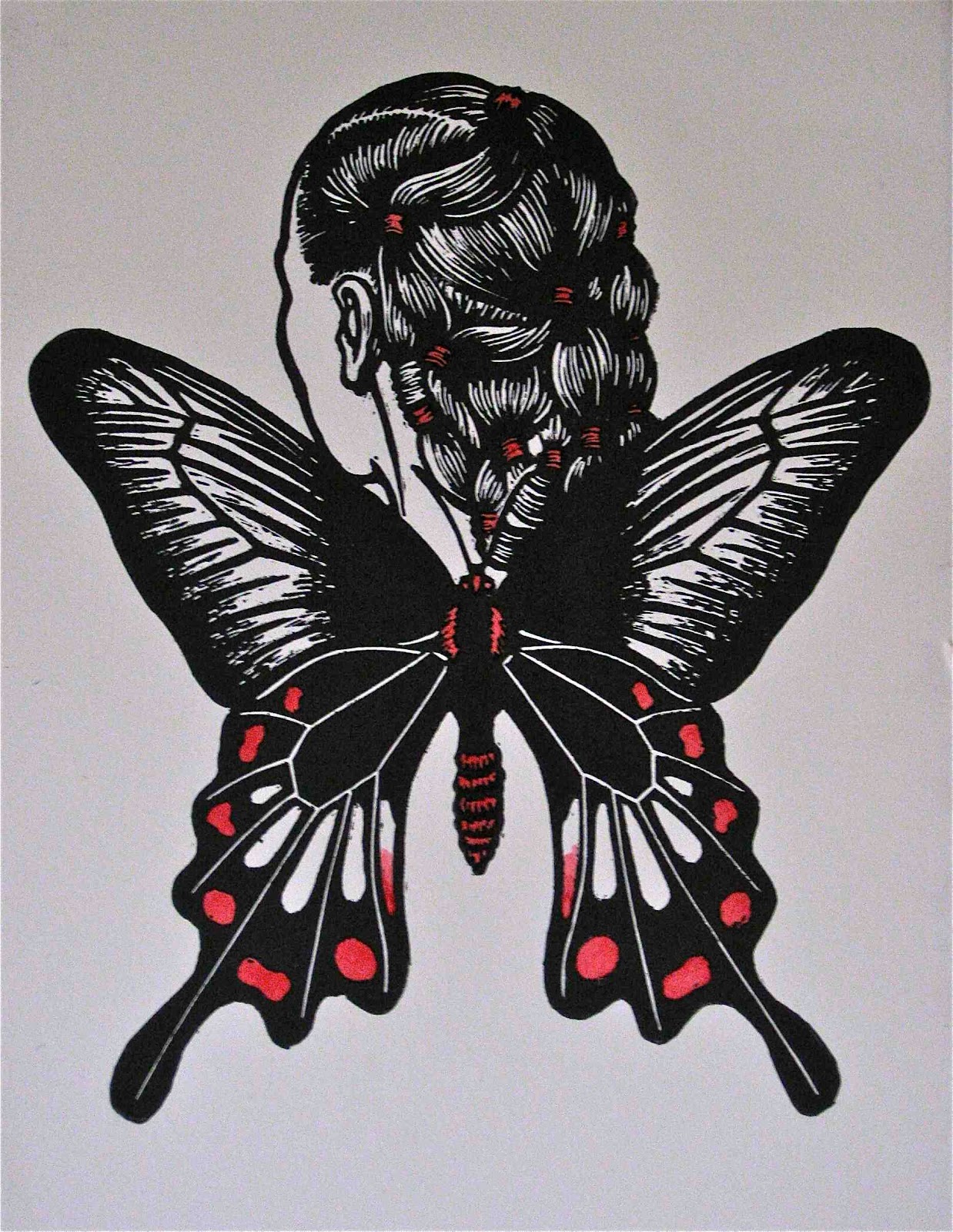
Pictured top left: Red Bodied Swallowtail Winged Woman, 2011, linocut, hand coloured

Thursday, March 1, 2012

The Spider Woman

The suite of linocuts based on sideshow identities is an ongoing labour of love, with no end as yet in sight, mainly because I'm constantly juggling it with other projects. But encouraged by some positive response to the first Sideshows and Funfairs feature (see Blog Post February 11) I’ve decided to preview another work in progress from the series.

Step right up, folks, and meet The Spider Woman:

The Spider Woman, 2012, lino block

The Spider Girl has long been a permanent sideshow fixture, eventually becoming better known as ‘Spidora’. By 1917 several greedy showmen were offering to disclose the secret of the illusion for an extra 25 cents, despite a letter of complaint to Billboard magazine from showman James A. ‘Fingers’ Wallace demanding that the practice be stopped.

Yet Spidora flourished and continues as a sideshow attraction to this day. At New York’s Coney Island her background was revealed by the Barker: “Step right up folks, meet ‘Spidora’, the Spider Girl. Born with the head and face of a beautiful girl and the body of an ugly spider, she survives in total misery, for no man could love her.” The Barker explained that she lived off her earnings as a sideshow freak, that she ate flies and other insects. But the Spider Girl illusion frequently backfired when even some of the most gullible spectators recognized the same girl’s head atop other exotic creatures, such as The Human Butterfly and The Snake Girl.

The Spider Girl is living testament that human beings love to be fooled - even when confronted with one of the most obvious illusions of all time.

Unlike the unhappy Spidora, however, the Red Back Spider/Woman hybrid depicted above is no fake and is definitely not to be crossed. She has more in common with the non-arachnid arch villain as portrayed by Gale Sondergaard (one of my favourite actresses) in the Sherlock Holmes movie Spider Woman, 1944, dir. Roy William Neill, whom Holmes acknowledges is as cunning as Moriarty and as venomous as a spider. So popular was Sondergaard’s portrayal, it spawned a non-Sherlock Holmes ‘sequel,’ the horror movie The Spider Woman Strikes Back.

Yes, folks, feast your eyes on the Spider Woman - but beware she doesn’t feast on you.

For your further edification, here is a short visual history of the Spider Girl Sisterhood (although The Crying Spider by Odilon Redon (second from top) is of somewhat indeterminate gender).

Arachne in Hell by Gustave Dore, engraving
(from 1861 edition of Dante's Inferno) 

The Crying Spider, 1881, by Odilon Redon, charcoal


Spidora at Copperdollar. Visit her at Copperdollar's
extraordinary website HERE.

Friday, February 24, 2012

Berlin Retrospective #2: The Berlin Wall and The East Side Gallery

Fragments of the infamous Berlin Wall are scattered throughout Berlin. A sizeable portion of the wall  has been retained by architects Kohlhoff and Kohlhoff as part of the extraordinary Berlin Wall Memorial. In reality there were two walls, one some distance behind the other. It’s no small wonder that anyone managed to escape at all. There is a permanent outdoor exhibition that gives a chilling insight into what life was like in a divided Berlin, including a memorial wall which honours those who died during attempts to escape from the east side into the west. Also on the site is the Chapel of Reconciliation. Adjacent is an Information Centre that relates the history of the wall through photographic exhibitions and a series of short films. Directly across the road is the Documentation Centre, complete with a lookout tower. A climb to the top is highly recommended. To read more about the Berlin Wall Memorial, click HERE.


Near the centre of Berlin is the longest outdoor gallery in the world. The East Side Gallery is a 1.3km long section of the Berlin Wall on which artists have also acknowledged the Wall’s dark history – but, like the Berlin Wall Memorial, more than anything their works commemorate the extraordinary courage and endurance of the human spirit.


Saturday, February 11, 2012

Sideshows and Fun Fairs

Here is a sneak peak at two linocuts in progress. They are part of a long-term project, begun in 2011 at The Art Vault, that is still very much in its early stages.

 Tattooed Woman, 2012 (lino block in progress)

Bearded Lady, 2012 (lino block in progress)

References to carnivals, circuses and sideshows have sporadically appeared in my work, dating way back to childhood scribbles - although thankfully none of these are extant. Doubtless my lifelong fascination with the subject is a direct result of growing up in Blessington Street, St. Kilda, which is walking distance from Luna Park. My recollections of it include the Giggle Palace and all the mind-boggling wonders within (it has long since been destroyed by fire), the River Caves, the stomach-churning Rotor, and an extraordinary ride (dating from around 1908, if memory serves me correctly) that originated in New York’s Coney Island. The exteriors of the latter’s elegant velvet lined carriages were exquisitely hand painted – but the whiplash-inducing ride itself was definitely not for those with delicate constitutions - even by today’s standards.

Although Luna Park had already started the sad, irrevocable process of passing its prime, it still retained much of its former magic. Now, despite the best efforts of its supporters, it’s all rather generic. The magnificent Heritage Listed merry-go-round is the sole survivor from its glory days.

Luna Park, St. Kilda,  circa 1960s

In cinema circuses, carnivals and sideshows are frequently sites of chaos and evil, particularly in Film Noir and the Mystery, Thriller and Horror genres. Some notable examples (and some of my personal favourites) include The Cabinet of Doctor Caligari, (dir. Robert Wiene, 1919) Freaks (dir. Tod Browning, 1932) Nightmare Alley (dir. Edmund Goulding, 1947) The Lady from Shanghai (dir. Orson Welles, 1947) and Strangers in a Train (dir. Alfred Hitchcock, 1951.)

The Cabinet of Dr Caligari (dir. Robert Wiene, 1919)

In direct contrast is the touching scene in Hitchcock’s picaresque Saboteur (1942) in which a troupe of circus ‘freaks’ are portrayed with warmth and compassion. It was partly, if not entirely, written by Dorothy Parker. Reportedly Hitchcock was delighted with her contributions to this segment, but believed that at the time of the film’s release its subtleties were lost on most audiences.

Saboteur (dir. Alfred Hitchcock, 1942)

Here are selected examples of carnival and sideshow related images that have featured in my past work. Some may be more familiar than others. The woodcuts from the Alice in the Cities series of the late 1980s have had relatively little exposure. They are the first five images directly below. For those who are familiar with The Cabinet of Dr Caligari, its influence on these works will be more than evident.

1. Thumbing a Lift, 1989, woodcut

 2. Dum and Dee, the Incredible Siamese Twins, 1989, woodcut

3.  Playing with Fire, 1989, woodcut

4.  The Dogs Bark, and the Caravan Moves On, 1989, woodcut

5. The Curtain Descends, Everything Ends, Too Soon, Too Soon, 1989, 
woodcut, hand coloured

6. Zelda Fitzgerald and her Psychiatrist, 1991, woodcut

7. See the Lady Sawn in Half! 1996, 
linocut (diptych)

8.  Lydia the Tattooed Lady, 1995, linocut

9. Kewpie Dolls, 1996, linocut