'I like a view, but I like to sit with my back turned to it.' Gertrude Stein 1874-1946
Tuesday, April 3, 2012
Dorothy Parker, Part 2
Saturday, August 6, 2022
I Wished on the Moon
After nigh on three-and-a half-decades as a practicing artist, the time is ripe to revisit and re-evaluate the past in order to clear a pathway for the creation of new narratives.
Accordingly, my current works gather together and re-contextualise the myriad of accumulated influences, motifs, themes and personal iconography that have directed it thus far. Among these are insects, particularly moths, and the meticulously braided hairstyles of my anonymous protagonists, the Rückenfiguren, or figures seen from behind.
From the outset, music has been a key influence. In this instance, the work begins and ends with the song from which it takes its title and much of its narrative content.
I first heard I Wished on the Moon several years ago on a reissue of Mel Tormé’s classic recording, Swinging on The Moon, a compilation of moon-themed jazz standards originally released in 1960.
It was one of the few songs on the CD I was unfamiliar with. Moved by the plaintive melody and bittersweet lyric, I was compelled to look into its authorship and history. The music was written in 1935 by Ralph Rainger, a prolific composer whose work I’ve long admired. But the real surprise was the identity of the lyricist. Dorothy Parker is best known as a writer of prose and poetry and is one of my favourite authors. Her writings have had a profound impact on many of my works. I was aware she was one of several people who contributed lyrics to the original production of Leonard Bernstein’s scathingly brilliant operetta, Candide (1956), but she is not generally known as a lyricist. I can find only one other lyric penned by her, and it’s also a standard. (1) I wish she had written more, and wonder why she didn’t.
‘’I begged of a star
To throw me a beam or two;
Wished on a star
And asked for a dream or two…”
And its chorus encapsulates the entire work:
“I wished on the moon
For something I never knew;
Wished on the moon
For more than I ever knew;
A sweeter rose, a softer sky, an April day
That would not dance away.”
I Wished on the Moon has its own Wikipedia Page, which lists some notable recordings. These are my own favourites: Ruth Etting (1935) Billie Holiday (1951) and Mel Tormé (1960). Notably, all three artists have chosen to retain its verse. By comparison, Bing Crosby, who introduced the song in the film, The Big Broadcast of 1936, where he performed it in its entirety, omitted the verse and sang only one chorus in his 78 rpm soundtrack recording.
Luna moth (Photo credit: Emmett Tullos, Jackson AL, US) (2)
Fittingly, the great winged insect that literally has my protagonist’s back is a Luna moth.
The founder of modern taxonomy, Swedish zoologist, physician and botanist, Carl Linnaeus (1707 - 1778), included the species in the tenth edition of his Systema Naturae, (1758). He named it Phalaena luna, later Actias luna, with luna derived from Luna, the Roman moon goddess. Subsequently, its common name became "Luna moth".
In mythology, the Luna moth is chiefly associated with rebirth, transformation, transience, resilience and new beginnings.
Ralph Rainger’s haunting melody, so perfectly matched by Dorothy Parker’s heart-rending lyric, played in my head throughout the creation of this work. Because of the song’s apparently idiosyncratic nature, however, I was initially reluctant to attach its title to my own work. In fact, Dorothy Parker’s lyric for I wished on the Moon transcends the personal. After all, who among us hasn’t wished on the moon, or even longed to go there?
My linocut I Wished on the Moon is part of the 2020-2022 APW George Collie Memorial Exhibition at the Australian Print Workshop, opening today, Saturday, 6 August.
The exhibition is current to Saturday, October 1.
(1) How Am I to Know? (1929). Music by Jack King, lyrics by Dorothy Parker. You can hear Billie Holiday sing it HERE.
(2) This file is licensed under the Creative Commons Attribution 2.0 Generic license. The image was originally posted to Flickr by ravensong75 at https://flickr.com/photos/12938199@N00/2494163376 (archive). It was reviewed on 18 November 2017 by FlickreviewR 2 and was confirmed to be licensed under the terms of the cc-by-2.0
Tuesday, August 23, 2022
Happy Birthday, Dorothy Parker
A slightly belated Happy Birthday to the late short-story writer, poet, screenwriter and critic, Dorothy Parker, who was born on 22 August 1893.
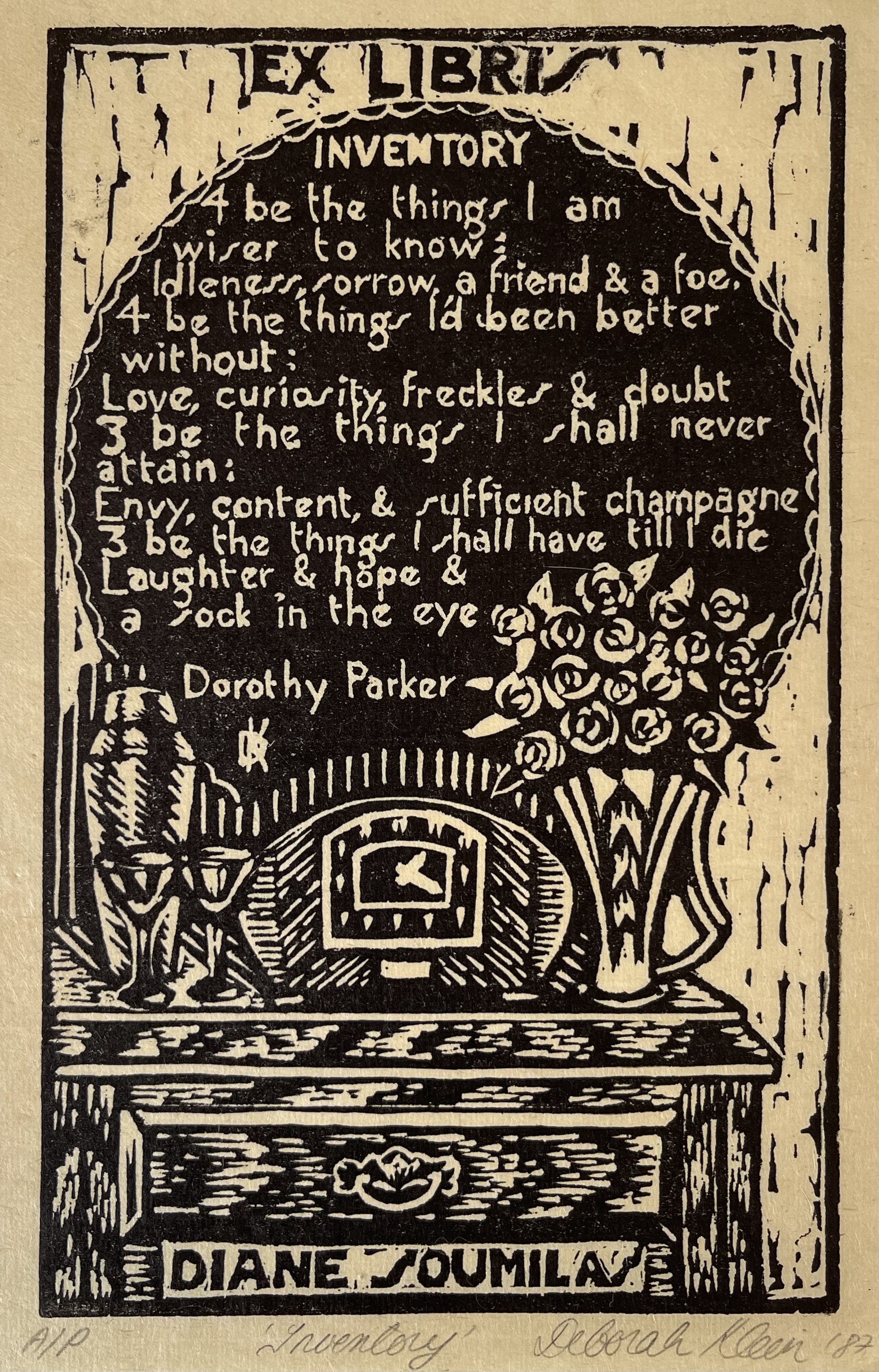
Currently I’m undertaking the mammoth task of cleaning out my plan cabinets and have just come across some dog-eared copies of this book plate, a linocut made as a birthday gift for a friend way back in 1987.
“Four be the things I am wiser to know:
Idleness, sorrow, a friend, and a foe.
Four be the things I'd been better without:
Love, curiosity, freckles, and doubt.
Three be the things I shall never attain:
Envy, content, and sufficient champagne.
Three be the things I shall have till I die:
Laughter and hope and a sock in the eye”.
Looking again at the image after many years, I’ve just realised the clock, vase, cocktail shaker and one of the two cocktail glasses are still in my possession.
Coincidences certainly abound today. I’d just finished posting the above on my social media pages when Shane brought in the mail. My London-based friends, Bev and Roger Murray, have sent me the attached article, clipped from the 9 July edition of The Times.
Thursday, March 29, 2012
Dorothy Parker, Part 1
As some visitors to this blog may be aware, I’m a longtime admirer of the poetry and prose of Dorothy Parker, which for me - and a great many others, I’m sure - gain in resonance with every passing year. Alternatively comedic and tragic, cruel and kind, cynical and sentimental, bitter and sweet, despairing and hopeful, they are filled with contradictions – but almost invariably razor-sharp. In one form or another, her verse and short stories have infiltrated my own work many times, both directly and indirectly. Here are some examples:
Sunday, March 8, 2009
Dorothy Parker's The Waltz

I don't want to dance with him. I don't want to dance with anybody. And even if I did, it wouldn't be him. He'd be well down among the last ten. I've seen the way he dances; it looks like something you do on Saint Walpurgis Night. Just think, not a quarter of an hour ago, here I was sitting, feeling so sorry for the poor girl he was dancing with. And now I'm going to be the poor girl. Well, well. Isn't it a small world?
....... What can you say, when a man asks you to dance with him? I most certainly will not dance with you. I'll see you in hell first. Why thank you. I'd like to awfully, but I'm having labour pains. Oh, yes, do let's dance together - it's so nice to meet a man who isn't a scaredy-cat about catching my beri-beri. No. There was nothing for me to do, but say I'd adore to. Well, we might as well get it over with. All right, Cannonball, let's run out on the field. You won the toss; you can lead.
Why, I think it's more of a waltz, really. Isn't it? We might just listen to the music a second. Shall we? Oh, yes, it's a waltz. Mind? Why, I'm simply thrilled. I'd love to waltz with you.
I'd love to waltz with you. I'd love to waltz with you. I'd love to have my tonsils out. I'd love to be in a midnight fire at sea. Well, it's too late now. We're getting under way. Oh. Oh, dear. Oh, dear, dear, dear. Oh, this is even worse than I thought it would be. I suppose that's the one dependable law of life - everything is always worse than you thought it was going to be. Oh, if I had any real grasp of what this dance would be like, I'd have held out for sitting it out. Well, it will probably amount to the same thing in the end. We'll be sitting it out on the floor in a minute, if he keeps this up.
I'm so glad I brought it to his attention that this is a waltz they're playing. Heaven knows what might have happened, if he'd thought it was something fast; we'd have blown the sides right out of the building. Why does he always want to be somewhere that he isn't? Why can't we stay in one place just long enough to get acclimated? It's this constant rush, rush, rush, that's the curse of American life. That's the reason that we're all of us so - Ow! For God's sake, don't kick, you idiot; this is only second down. Oh, my shin. My poor, poor, shin, that I've had since I was a little girl!
Oh, no, no, no. Goodness no. It didn't hurt the least little bit. And anyway, it was all my fault. Really it was. Truly. Well, you're just being sweet to say that. It really was all my fault.
.......I'm past all feeling now. The only way I can tell when he steps on me is that I can hear the splintering of bones. And all the events of my life are passing before my eyes. There was the time I was in a hurricane in the West Indies, there was the day I got my head cut open in the taxi smash, there was the night the drunken lady threw a bronze ash-tray at her own true love and got me instead, there was that summer what the sailboat kept capsizing. Ah, what an easy, peaceful time was mine, until I fell in with Swifty here. I didn't know what trouble was, before I got drawn into this danse macabre. I think my mind is beginning to wander. It almost seems to me as if the orchestra were stopping. It couldn't be, of course; it could never be. And yet in my ears there is a silence like the sound of angel voices....
Oh, they've stopped, the mean things. They're not going to play any more. Oh, darn. Oh, do you think they would? Do you really think so, if you pay them twenty dollars? Oh, that would be lovely. And look, do tell them to play this same thing. I'd simply adore to go on dancing.
Excerpts from The Waltz by Dorothy Parker. From The Original Portable as Arranged by Dorothy Parker in 1944.
Pictured above: The Dance, 1997, linocut, chine colle 37 x 37 cm
Saturday, January 7, 2012
The Ghost of Artworks Past
Above left: 4 The Letter, 1995
Above right: 5 Mildred Pierce on St. Kilda Pier, 1995
A selection of my old pictures, including several from that vexed pre-1996 period, now grace the walls of the house at Ballarat, thus creating some sorely needed space in our storage area in Melbourne. Some deserved to once again see the light of day far more than others, and these were hung soon after we moved in. But those I felt more ambivalent about remained stacked against a wall for nearly a year. We finally hung them over the Christmas break. Several are in my studio. We are gradually learning to coexist and I realize that I might actually be able to learn something from them. It's starting to feel like it could be a positive place from which to begin a new year and a new body of work.
Pirate Jenny is a character in The Threepenny Opera, by Kurt Weill (music) and Bertolt Brecht (book and lyrics). Ostensibly set in London, its spiritual home was Berlin, where it premiered in 1928. I transplanted its original location to scruffy, pre-gentrified St. Kilda in Melbourne, where I was then living and working. The Pirate Jenny Prints were published by Port Jackson Press, Melbourne and subsequently toured nationally. Euan Heng wrote the introduction to the catalogue that accompanied the tour.
4 and 5 (see below)
Pictures from left:
Unlike most of my work, this image is not connected to a thematically linked series. This sad but spirited wallflower was inspired by a poignant group of photographs from the 1950s, taken at a high school dance when American film legend James Dean paid a return visit to the small town where he was raised.
The Letter, 1995, oil on canvas, 61 x 51 cm
These are linked to the Film Noir series of the mid 90s. They are two of the few surviving paintings from that period. As the series progressed, I found that the nocturnal world of film noir was best served by the linocut medium. In fact both images were subsequently developed into linocuts. They were included, along with the linocuts, in my second solo exhibition at Australian Galleries, Melbourne, in 1996. (*For more on Mildred Pierce, see Blog Post February 12, 2011.)
This drawing takes its points of departure from two of Dorothy Parker’s poems. It was originally part of a 1992 solo exhibition, my first at Australian Galleries in Melbourne. The exhibition focused on the lives and work of writers Dorothy Parker, Zelda Fitzgerald and Virginia Woolf. The series was also exhibited at Solander Gallery in Canberra.
Pictures from left:
Fairgrounds and circuses often feature in Film Noir. This is one work I’ve always had a certain fondness for.
The danger inherent when anyone gets behind of the wheel of a car was exploited regularly in Film Noir. When researching this work, I derived particular inspiration from the superb Nicholas Ray film In a Lonely Place (1950) and the Bette Davis camp classic Beyond the Forest (dir. King Vidor, 1949, in which she utters the celebrated line, long beloved by Davis impersonators, "What a Dump!") This drawing was transposed into a linocut, which in my opinion worked much better. Both versions also debuted at Australian Galleries, Melbourne in 1996.
Wednesday, June 29, 2016
The Moth Women Vigilantes Hall of Infamy (Part 1)
My choice of markers: black, white blender, colourless blender and a range of warm and cool greys, reflects the bygone era of the silver screen.
Reinvented as a member of the MWV, Louise Brooks is pictured above, with W&N markers providing a sense of scale.
Another woman ahead of her time, Alla Nazimova joins the growing ranks of Moth Woman Vigilantes in this second Winsor and Newton pigment marker exercise.
With the exception of her newly acquired MWV mask, this Winsor and Newton Pigment Marker drawing shows Bette Davis much as she appeared in Whatever Happened to Baby Jane? right down to the insect brooch adorning her beret.
Throughout the series, Nora is Nick's equal. She matches him in intellect, guts and nerves, wisecrack for wisecrack, cocktail for cocktail. Their natural, easygoing rapport, mutual respect and affection (which Loy and Powell shared in real life) rang so true that many people mistakenly believed they were really married.
Despite her long, distinguished career, Loy was never nominated for an Academy Award, an oversight deplored by the Moth Women Vigilantes. Believing the Honourary Oscar she received in 1991 was too little, too late, they have awarded her their highest honour: induction to the Moth Woman Vigilantes Hall of Infamy.
.jpg)