Pages


Tuesday, July 14, 2015

Fully formed Metaxymorpha nigrofasciata Beetle Woman

A rainbow-hued Homo-insecta is released from her warm cocoon into the cold, grey Australian winter:

Metaxymorpha nigrofasciata Beetle Woman, 2015, acrylic on wood, 32 x 30 cm

Pictured above: completed Metaxymorpha nigrofasciata Beetle Woman, followed by further progress views. (See also previous post).

Metaxymorpha nigrofasciata Beetle Woman, 2015, acrylic on wood, 32 x 23 cm


Wednesday, July 8, 2015

An emerging Homo-insecta: Metaxymorpha nigrofasciata Beetle Woman

Of all the Homo-insecta we have been documenting of late, Metaxymorpha nigrofasciata Beetle Woman is surely among the most beautiful. She is also proving to be one of the most challenging to capture, if only in paint on wood. We hope we can eventually do her justice.


Pictured above are some early progress views of Metaxymorpha nigrofasciata Beetle Woman (2015, pencil, gesso and acrylic on wood, 32 x 30 cm). She evolved from the rainbow-hued jewel beetle Metaxymorpha nigrofasciata, which you can view HERE.

Thursday, July 2, 2015

A visit to Newstead

Last week my partner Shane Jones and I visited our friends Leigh Hobbs and Dmetri Kakmi at the cottage in Newstead that they’ve periodically house sat for many years. It was our first visit to the cottage, which was utterly charming, and also the first occasion we’ve taken time to explore the area. After a hearty lunch (doubly welcome on such a cold day, as was the open fire) we all went for a walk in the nearby woods, accompanied by Dmetri and Leighs’ two eager hounds Snowy and Lulu.

Newstead is about 15 kms from Castlemaine; both are part of the historic Goldfields area of Victoria. The crevices and potholes in the photos below are remnants of its goldmining history. I have a project relating to this very subject looming (more about this in a future post) and was able to collect a great deal of reference material, namely the leaves (mainly eucalyptus) some of which are pictured in the final photograph below.

For a short history of Newstead, click HERE.

Into the woods

The man-made crevice (above) and pothole (below) date from the gold mining era

Left: Leigh Hobbs; right: Shane Jones

Shane and Dmetri Kakmi

Aside from a few scattered bricks, there is little evidence of the cottage that once occupied this spot

At the approach of dusk: Shane, Leigh, Snowy and Lulu

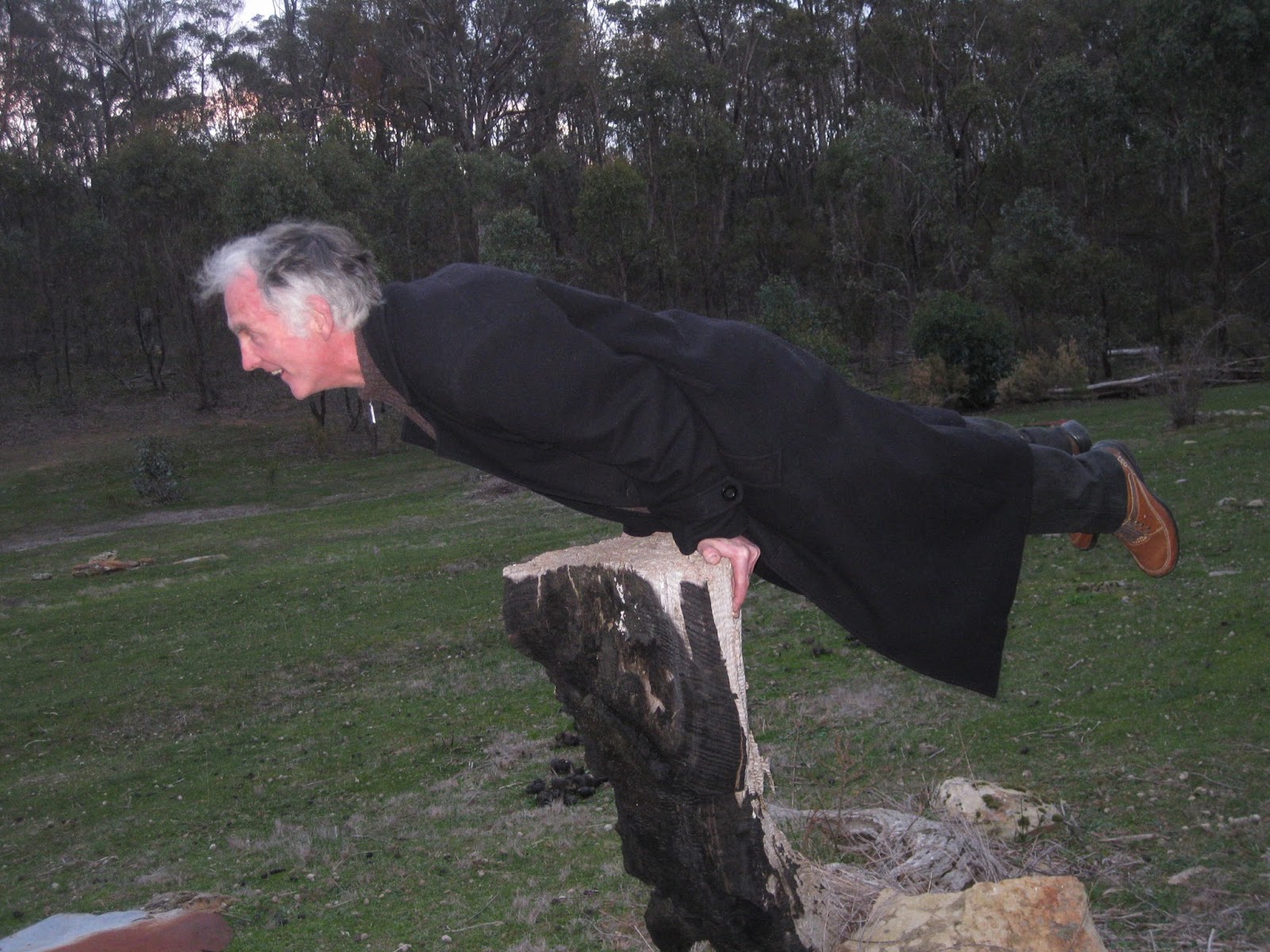
Shane in a spontaneous moment of levity - or possibly an attempt to levitate

A small selection of my own treasures gleaned from Newstead's goldfields

Saturday, June 27, 2015

A Box of Beetles and a Line of Insect Women

A Box of Beetles was a recent lucky find in Horton Books, a favourite Melbourne bookstore. Located in Smith Street, Collingwood, it’s fairly local to our Melbourne place. Sadly, after 15 years in the area, Horton Books will close its doors in July. It’s a great shame to see the demise of another independent bookshop, particularly when it’s as special as this one.

Meanwhile, the diminutive treasure chest pictured below will provide me with rich and varied source material for a long time to come.

The Box of Beetles yields some of its treasures

As I research my next Homo-insecta works, here is the story so far, at least for the paintings on wood:

The first nine Homo-insecta paintings (acrylic on wood panels, 2015). Studio view, late June.

Thursday, June 25, 2015

Fully Formed Luna Moth Woman

Final stages in the evolution of Luna Moth Woman:


Deborah Klein, Luna Moth Woman, 2015, acrylic on wood panel, 32 x 30 cm

Friday, June 19, 2015

Nascent Luna Moth Woman


Further stages in the transfiguration of Actias luna moth to Luna Moth Woman.


Tuesday, June 16, 2015

Emerging Luna Moth Woman


Early progress views of Luna Moth Woman, 2015, pencil, gesso and acrylic on wood, 32 x 30 cm:


Thursday, June 11, 2015

A Homo-insecta in the making: Actias luna Moth


Lately I’ve been researching the ethereal Luna Moth (Actias luna) as a potential candidate for transformation into a Homo-insecta. Currently the Luna Moth lives solely to lay eggs and will survive a mere seven days. Once her evolution to Homo-insecta is completed, however, she will be expected to live richly and fully for several decades

Enlarged view of Actias luna Moth antenna

Macro view of Actias luna eyespot

This is not the first time the Luna Moth has appeared in my work. Previously it featured in the painting Actias luna Moth Mask, 2007, which was part of the Moth Masks series of paintings, drawings and prints (2007-09).

Actias luna Moth Mask (2007, acrylic on canvas, 25 x 20 cm)

Monday, June 1, 2015

Bluebottle Fly Woman, Part 2

As I've recently mentioned, the level of exactitude required with Homo-insecta such as Bluebottle Fly Woman is hard won (see Blog Post, Tuesday, May 19) but I’m learning a lot in the process. For beginners, I’ve now discovered that methylated spirits, delicately applied with a soft rag, will erase unwanted pencil marks. Unbleached Titanium acrylic paint, used sparingly, can be similarly employed, either to make minor corrections or refine the outer edges of the image. Its tint (lightened, if necessary, with a touch of warm Ivory White) is a near enough to perfect match to the blonde wood panels).

As with previous paintings on wood, surfaces were built in gradual layers. In this work, textures and highlights were created with extensive hatching and cross-hatching - techniques more readily associated with drawing, particularly pen and ink - or even with mark-making in certain printmaking processes.

Pictured below: Completed Bluebottle Fly Woman, 2015, acrylic on wood, 32 x 30 cm, followed by a series of progress views in reverse.


Thursday, May 28, 2015

Blue Bottle Fly Woman, Part 1

Currently being documented in the studio: Bluebottle Fly Woman, a recently discovered Homo-insecta. She evolved from the Northern Bluebottle fly, a species of common Blow Fly (scientific name: Protophormia terraenovae). More about these much-maligned flies can be found HERE.

Several stages up the evolutionary scale from pesky (and exceedingly stupid) Blowies, Bluebottle Fly Woman is not only beautiful, but also extremely bright.

In April 2015 an enlightening and stunningly photographed documentary, The Great Australian Fly screened on Australian ABC television which corrected a number of misconceptions about flies. For details, go HERE.

Pictured below: Initial stages of Bluebottle Fly Woman, 2015, pencil, gesso and acrylic on wood, 32 x 30 cm.


Monday, May 25, 2015

Plusiotis victorina Beetle Woman, Part 3

Plusiotis victorina Beetle Woman, 2015, acrylic on wood, 32 x 22 cm

The Homo-insecta Plusiotis victorina Beetle Woman (captured in the newly completed painting directly above) evolved from a species of jewel scarab that is native to Mexico.


Respectively above and below are the front cover and a double page spread from an old copy of National Geographic (February 2001) that I recently unearthed in a Melbourne thrift shop. It will give some idea of the shimmering beauty and extraordinary diversity of these insects. Plusiotis victorina can be seen first on the left, second row from the top.


A visit to the University of Nebraska’s Division of Entomology website is highly recommended. For a more detailed view of individual Scarabs, go to their web page: Generic Guide to New World Scarab Beetles. A page devoted entirely to Plusiotis victorina (AKA Chrysina victorina) is HERE.

Friday, May 22, 2015

Plusiotis victorina Beetle Woman, Part 2

Aside from the technical issues mentioned in my last post, which I’m certain are not insoluble, I'm finding painting onto wood extremely satisfying. It feels very much as if the materials are working with me, not against me.

As outlined previously, and as demonstrated by the following progress views, colours have been carefully built in transparent and semi-transparent layers before adding details. The metallic areas of the chitin (protective outer casing) and legs have painted with metallic gold over brown, gradually building to warmer coppery tones with applications of transparent orange and browns. 


Pictured above: progress views of Plusiotis victorina Beetle Woman, 2015, acrylic on wood, 32 x 22 cm.

Tuesday, May 19, 2015

Plusiotis victorina Beetle Woman, Part 1


The current Homo-insecta paintings on wood are companion pieces to the watercolours (2014 - present) that I’ve put on temporary hold while I get this series under way. As mentioned in a previous post, this is not the first time I’ve painted on wood. In past times, however, the surface was prepared with two or three coats of gesso, with a light sanding (using a fine-grained sandpaper) in between each layer. The preparation of these panels is similar, except that instead of gesso, the wood is coated with a clear primer, resulting in a protective, non-darkening surface which retains the subtle wood grain. After the figure is outlined in pencil, 2 – 3 coats of gesso are applied to the image area, through which the outlines of the drawing remain visible.


The first paintings on small square panels measuring 20 x 20 cm were essentially an experiment to get a feel for this new method of working and, as much as possible, learn to deal with any technical challenges it might throw my way.

Plusiotis victorina Beetle Woman is the third Homo-insecta to be painted on a panel measuring a slightly larger 32 x 23 cm. Still at the relative beginning of a wide, frequently daunting learning curve, I’ve learned some key lessons from my previous efforts – principally, the necessity to work with even more than usual care, leaving very little to chance. The exposed wooden surface is particularly unforgiving in regard to pencil marks; if there are any mistakes in the drawing, or I simply want to make a minor adjustment, it is almost impossible to remove unwanted marks that fall outside the painted area. In many other instances, alterations and erasures (notably in the powerful large scale drawings of William Kentridge) can lend tremendous vigour to an image. The Homo-insecta series, however, takes natural history illustration as its point of departure, and a meticulous aesthetic and sense of stillness is essential. Erasures and alterations merely make the image look grubby.


The fast drying nature of acrylic paints can be a plus with smaller sized works, but as the scale increases, the blending of colours – for example, skin tones – can be extremely difficult. In the two stage views directly above, the first layers of colour have been applied. Painting wet-on-wet, a standard blending technique in oil painting, doesn't always work well with acrylics; all too often the paint lifts completely away. Instead, I'm gradually building areas of colour and tone via a series of thin washes, first making sure that each previous layer is completely dry.

Friday, May 15, 2015

Ladybird Beetle Woman (final version)

Started in 2014, but extensively reworked this year: Ladybird Beetle Woman, pencil and watercolour on Khadi Paper 41.91 x 29.72 cm. The changes are subtle, and not easily discerned in reproduction; the most significant difference is in her hair, to which I've added warmer tones. To see the earlier version of this work (including a series of progress views) go to Blog Post Tuesday 8 July 2014.