Pages


Tuesday, May 12, 2015

2015 Ballarat Heritage Weekend


Lately it seems to have been raining constantly at Ballarat. But there are compensations - like this exquisite raindrop-encrusted spider web recently photographed outside my studio. A remarkable feat of spinning and engineering, it was improbably suspended between our Hills Hoist clothesline and the vegetable patch, having weathered a particularly dramatic storm the night before.

Unfortunately the weather didn’t improve much for last weekend’s Ballarat Heritage Weekend, an event my partner Shane Jones and I had eagerly anticipated ever since attending the festival for the first time last year. Fortunately, all the events we visited were indoors based, and all were simply wonderful.

Aprons on parade at the 2015 Ballarat Apron Festival

Our first port of call was the Ballarat Apron Festival, co-organised by our friend and neighbour, Heather Macleod (pictured below) who declared that she thought of us when she was ironing the aprons pictured above and below. Lent by a private collector, several were worn by the character Jean Beazley (Nadine Gardner) in the celebrated ABC TV series Dr Blake’s Mysteries, which, for the uninitiated, is set in late 1950s Ballarat. In turn, I thought of my friend, Arizona-based artist Deborah McMillion, who is also a devotee of the show.

The ever-stylish Heather Macleod

At morning tea we were delightfully serenaded by a group of ukulele players

Vintage apron, a personal favourite among dozens of personal favourites

Shane with his personal pick: an homage to the legendary Australian racehorse, Phar Lap

In the Ballarat Gold Exchange in Lydiard Street, it was a treat to finally meet artist/printer Lawrence Finn, Director of Hipcat Printery in Kyneton. Also in Lydiard Street, we joined a guided tour of the membership-only Old Colonists Association, where the fictional Dr Blake frequently calls in for a tipple. The tour guide informed us that the actor Craig McLaughlan, who plays Dr. Blake, recently became a member. After the tour of this magnificent building, which was founded by veterans of the Eureka Stockade, we stepped out on to the balcony to enjoy stunning views of historic Lydiard Street. Later in the day, Shane and I demonstrated what Doctor Blake tragics we really are by calling into the cozy bar for a glass of wine.

The bar of the Old Colonists Association

From the Old Colonists balcony: LHS, the Mining Exchange and distant centre: Craig's Royal Hotel

Our favourite cinema, the Regent, viewed from the Old Colonists balcony. Later we called into the cinema for a
screening of vintage newsreels

Shane enjoys the view and the music of the Ballarat Memorial Concert Band 

Directly opposite, on the first floor balcony of the George Hotel, the Ballarat Memorial Concert Band played up a storm 


Two highlights of the day were concerts at the Mechanics Institute: at 4 pm, The Pacific Belles, a dazzling Andrews Sisters-inspired trio (we immediately pronounced ourselves lifelong fans) and at 4.30, a solo performance by talented Creswick-based chanteuse Aimie Brûlée.

Outside the Mechanics Institute, prior to the concerts, we bumped into Judith and Joel, two old friends we haven’t seen for several years. The four of us ended the day with a civilised coffee at the palatial Craig’s Royal Hotel (Mark Twain is its most famous guest) then going out for a meal and a further catch-up, followed by a solemn vow not to leave it so long until our next meeting.  

Meanwhile, Shane and I are already hanging out for the 2016 Ballarat Heritage Weekend.

Monday, May 11, 2015

Coming Attraction

Snapped at the picture framer, Omnus, during a flying visit to Melbourne on Saturday: three linocuts from the vintage Tattooed Faces and Figures series, moments before they were cocooned in bubble wrap. In August they will reemerge for Inking Up, a three-person tattoo-themed exhibition at Castlemaine Art Gallery and Historical Museum. The show will also feature linocuts by Rona Green and the exhibition's curator, Clayton Tremlett. (See also Blog Post, Tuesday, March 3).

Pictured L-R: St. Kilda Warrior (1996) Tattooed Face No. 1 (1995) and Lace Face (1996) by Deborah Klein

Friday, May 8, 2015

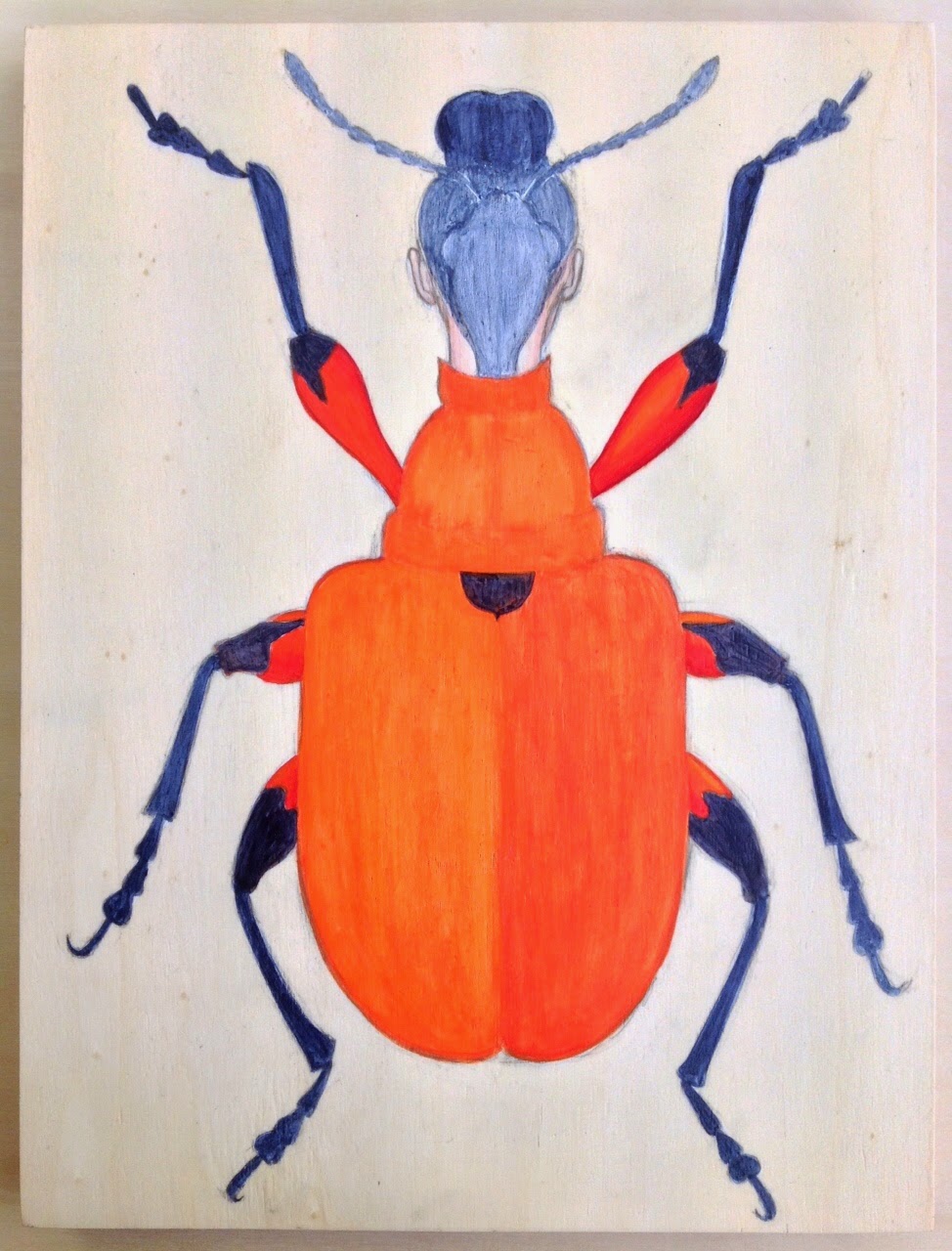
Apoderus coryli Beetle Woman #3

Pictured below: final stages of Apoderus coryli Beetle Woman, 2015, acrylic on wood, 32 x 23 cm. (For more about this Homo-insecta, see previous two posts).


Saturday, May 2, 2015

Apoderus coryli Beetle Woman #2

In the Ballarat studio I’m currently documenting the Homo-insecta, Apoderus coryli Beetle Woman. To see the European beetle from which she evolved (AKA Hazel Leaf-roller and Hazel Leaf-rolling Weevil) go HERE and HERE.


Pictured above: interim stages of Apoderus coryli Beetle Woman, 2015, pencil and acrylic on wood, 32 x 23 cm.

Friday, May 1, 2015

Apoderus coryli Beetle Woman #1


Pictured below: Preparatory stages of Apoderus coryli Beetle Woman, 2015, 32 x 23 cm. Top: pencil on wood; Base: pencil, gesso and acrylic on wood.


Sunday, April 26, 2015

The Piano Has Been Drinking at Maitland Regional Art Gallery


The Piano Has Been Drinking (Not Me) 2014, ink with touches of gouache 
on A4-sized Khadi paper. Collection: Maitland Regional Art Gallery, NSW.

The drawing reproduced above marks a momentary return to silhouette imagery. It was made late last year, in response to a brief from Jo Eisenberg, Cultural Director of Maitland Regional Art Gallery in NSW and curator of a forthcoming exhibition in which invited artists were asked make a work on paper based on this song by Tom Waites:

The Piano Has Been Drinking (Not Me)

The piano has been drinking, my necktie is asleep
And the combo went back to New York, the jukebox has to take a leak
And the carpet needs a haircut, and the spotlight looks like a prison break
And the telephone's out of cigarettes, and the balcony is on the make
And the piano has been drinking, the piano has been drinking...

And the menus are all freezing, and the light man's blind in one eye
And he can't see out of the other
And the piano-tuner's got a hearing aid, and he showed up with his mother
And the piano has been drinking, the piano has been drinking
As the bouncer is a Sumo wrestler cream-puff casper milquetoast
And the owner is a mental midget with the I.Q. of a fence post
'Cause the piano has been drinking, the piano has been drinking...

And you can't find your waitress with a Geiger counter
And she hates you and your friends and you just can't get served without her
And the box-office is drooling, and the bar stools are on fire
And the newspapers were fooling, and the ash-trays have retired
'Cause the piano has been drinking, the piano has been drinking
The piano has been drinking, not me, not me, not me, not me, not me...

Tom Waites (1977)

For those unfamiliar with the song, I recommend the link below; the words and music are best savoured in unison, especially when performed by its inestimable composer:

Although Waite's crazy, hallucinogenic lyric draws word pictures that are worthy of Magritte, I haven't attempted to illustrate the song. My work is drawn from the mental picture that was summoned like a genie from a bottle the first time I played the song. The stiff necked protagonist’s starched collar and tightly buttoned dress recall the pleasure-shunning Puritans. Her "bonnet", however, takes the form of a piano. This is a Puritan in denial; despite herself, it seems she is more in tune with the drunken piano.

The Piano Has Been Drinking (Not Me) is one of eight works on paper exhibitions at MRAG, collectively titled JUST PAPER, that will run concurrently between 2 May and 22 June. For full details, go HERE.

Friday, April 24, 2015

22-Spot Ladybird Woman #3: How the Ladybird Got Her Spots


Pictured above: 22-Spot Ladybird Woman (Psyllobora vigntiduopunctata Homo-insecta) 2015, acrylic on wood, 32 x 23 cm. (Artist’s impression).

To date, the exact measurements of this recently discovered Homo-insecta are unknown. Based on numerous eyewitness accounts, she is approximately 26 cm in length (even taller when she lets her hair down) x 13.5 cm in width. Miniscule by comparison, the European insect from which she evolved, Psyllobora vigntiduopunctata (abbr. Psyllobora 22-punctata) measures a mere 3-5 mm.

Pictured below (and also previous 2 blog posts): selected views of the documentation process.


Tuesday, April 21, 2015

Work in Progress: 22-Spot Ladybird Woman #2

22-Spot Ladybird Woman: gradually taking on colour and almost ready for her spots.


Pictured above: more developmental views of 22-Spot Ladybird Woman, 2015, pencil, gesso and acrylic on wood, 32 x 23 cm (see also previous post).

Friday, April 17, 2015

Work in Progress: 22-Spot Ladybird Woman

Beginnings of a new painting:  22-Spot Ladybird Woman (Psyllobora viginitiduopunctata Homo-insecta) pencil on wood (top image); pencil and gesso on wood (bottom image) 32 x 23 cm.


Saturday, April 11, 2015

Moth Woman Mail Art #2

True to their conviction that it's well and truly time for a change, the Moth Woman Vigilantes have also commissioned a 2015 Republic of Mothstralia 55c stamp. (See also previous post, Monday, April 6).


 2015 Republic of Mothstralia 55c stamp (enlargement). Original artwork: Deborah Klein,
Dysphania cuprina Moth Woman, 2009, acrylic on canvas, 25 x 30 cm)

Set of 2015 Republic of Mothstralia 55c stamps (actual scale)


Monday, April 6, 2015

Moth Woman Mail Art

Ever the optimist, I’m still imagining and imaging a brave new order in which the Moth Woman Vigilantes* take us under their collective wing. (It couldn’t be any worse than what we have now).

Step 1: Designing new sets of Mothstralian postage stamps, the first of which is previewed here.

2015 Republic of Mothstralia 20c stamp (enlargement). Original artwork: Deborah Klein,
Coscinocera Hercules Moth Woman, 2009, acrylic on canvas, 25 x 30 cm)

Set of 2015 Republic of Mothstralia 20c stamps (actual scale)

The "stamps" were constructed by combining my artwork with the iPad apps Face on Stamps, Square Ready and Strip Design.

(*Notorious fighters for freedom, equality and social justice, whose true identities have never been uncovered. See also: Blog Post March 8, 2013).

Saturday, April 4, 2015

Editions (Redux)

Spider-hunting Wasp Woman, 2014, hand coloured linocut, 29.5 x 21 cm, edition: 30

Editions (Redux) currently showing at Tacit Contemporary Art, is essentially a reduced version of Editions 2015, the gallery's recent exhibition of Victoria-based printmakers that featured eight of my linocuts (see Blog Post Saturday, February 21). Spider Hunting Wasp Woman (pictured above) is one of six Homo-insecta making a return appearance.

The complete lineup of artists (15 of the original 34) is:
T. J. Bateston, Louise Donovan, Kevin Foley, Peter Garnick, Ying Huang, Kyoko Imazu, Hyun Ju Kim, Deborah Klein, Damon Kowarsky, Kir Larwill, Marion Manifold, Soula Mantalvanos, Stephanie Jane Rampton, Trudy Rice and Joel Wolter.

Editions (Redux) is curated by Keith Lawrence. The exhibition runs until 12 April.

Tuesday, March 31, 2015

Coming soon to a wasp plague near you: European Wasp Woman

The watercolour, Wasp Woman was begun, but not quite completed, during my term as artist in residence at the Art Vault in Mildura last December (see Blog Post Friday, December 12, 2014).

After the residency ended, Christmas and all its attendant distractions intervened, and then there were further insect women waiting to be documented. It’s only now I’ve had a chance to add the finishing touches to this homo-insecta and give the sting in her tail one last polish – just in time for her to partake in the wasp plague currently upon us in Ballarat.


Wasp Woman (Vespula germanica homo-insecta) 2015, watercolour 
and gouache on Khadi paper, 41.91 x 29.72 cm.

Thursday, March 26, 2015

Hibiscus Harlequin Bug Woman, Part 2


Hibiscus Harlequin Bug Woman, 2015, acrylic on wood, 20 x 20 cm

Now full-fledged, Hibiscus Harlequin Bug Woman (Tectorcoris diopthalmus homo-insecta) shows her true colours. 

Directly below: selected views of the documentation process. (For more, scroll down to previous post, Saturday, March 21).

Work in progress #3: Hibiscus Harlequin Bug Woman, 2015,  pencil, gesso and acrylic on wood, 20 x 20 cm

Work in progress #4: Hibiscus Harlequin Bug Woman, 2015, acrylic on wood, 20 x 20 cm

Saturday, March 21, 2015

A work in progress: Hibiscus Harlequin Bug Woman

AKA Tectorcoris diopthalmus Woman and Cotton Harlequin Bug Woman, this luminescent Homo-insecta hails from Northern and Eastern Australia, New Guinea and several of the Pacific Islands. Adult females are predominantly orange with blue patches, although the colours vary considerably. The female of the species is larger than the male.

The Hibiscus Harlequin Bug Woman feeds on several species of the Hibiscus family, cultivated cotton, flame free flowers, grevillea and bottlebrush saplings.

Work in progress #1: Hibiscus Harlequin Bug Woman, 2015, pencil on wood, 20 x 20 cm

Work in progress #2: Hibiscus Harlequin Bug Woman, 2015, pencil and gesso on wood, 20 x 20 cm

Monday, March 16, 2015

Between the Sheets

Top: Between the Sheets: Installation view, Gallery Central, Perth, WA
Base: Homo-insecta - An Unnatural History Portfolio, 2013, artist book, hand coloured linocuts and inkjet prints, 33H 24W x 1.5D cm, edition 2/10.

An installation view of Between the Sheets, the international artist books exhibition that includes my unbound book, Homo-insecta (foreground, right) inset below with the front cover and selected page views.

Between the Sheets
Gallery Central
12 Aberdeen Street
Perth
Western Australia

The exhibition opened on 7 March and runs until 2 April.

For full details of the exhibition, visit Moth Woman Press HERE.

Sunday, March 15, 2015

Ellen Terry, John Singer Sargent and the Beetle Dress


Further to my previous post, which focused on the newly completed Jewel Beetle Woman (Sternocera aequisignata) now present my Muse: Dame Ellen Terry (1847-1928) as Lady Macbeth, a role she famously performed on the West End of London in 1888. Amongst the crowd on opening night was the painter John Singer Sargent (1856-1925) who later persuaded her to sit for him. An eye witness to Terry’s arrival at Sargent’s Chelsea studio was none other than Oscar Wilde, who remarked: “The street that on a wet and dreary morning has vouchsafed the vision of Lady Macbeth in full regalia magnificently seated in a four-wheeler can never again be as other streets: it must always be full of wonderful possibilities."

Left: John Singer Sargent, Ellen Terry as Lady Macbeth, 1888, oil on canvas, 221.0 x 114.3 cm. Collection: Tate
Right: The Beetle Dress, designed by Alice-Comyns-Carr and constructed by Ada Nettleship: restored to its
former glory. Collection: Ellen Terry Museum, Smallhythe Place

Alice Comyns-Carr designed the gown, which you can read about HERE. Ada Nettleship crocheted it from a combination of soft green wool and blue tinsel yarn from Bohemia that was primarily intended to evoke chain mail, whilst also suggesting the scales of a serpent. The dress was sewn with 1000 iridescent wings from the green Jewel Beetle Sternocera aequisignata.

Terry kept the ‘beetle dress’ for the rest of her life and sometimes wore it on special occasions. The gown now resides in the permanent collection of the Ellen Terry Museum, Smallhythe Place, near Tenterden in Kent, UK. I first visited this beautiful museum, which was formerly Terry’s home, in the mid-1970s and returned in 2011, soon after a major restoration of the gown had been undertaken. You can learn about it HERE and HERE.


Thursday, March 12, 2015

Jewel Beetle Woman (Sternocera aequisignata)

Now fully-formed, the newest member of the Homo-insecta species makes her debut appearance below, followed by further details of the documentation process. (See also previous post, Sunday, March 8).

Jewel Beetle Woman (Sternocera aequisignata), 2015, acrylic on wood, 20 x 20 cm

Jewel Beetle Woman (Sternocera aequisignata) detail of work in progress, March 2015

Jewel Beetle Woman (Sternocera aequisignata) work in progress, March 2015

Sunday, March 8, 2015

Emergent Jewel Beetle Woman

Early stages of Jewel Beetle Woman (Sternocera aequisignata) 2015, acrylic and pencil on wood, 20 x 20 cm.


Tuesday, March 3, 2015

A meeting at Rona Green's studio

Yesterday afternoon (Monday, 2 March) I met with printmakers Clayton Tremlett and Rona Green at Rona's wonderful studio in the Mercator Building, which is part of the extensive Abbotsford Convent arts complex.

Clayton is the curator of Inking Up, a forthcoming exhibition at Castlemaine Art Gallery and Historical Museum; it will comprise linocuts by the three of us, all on the theme of the tattoo.

Inking Up will run from 29 August - 18 October. Full details will be posted nearer the time.

The following photos were taken during the initial selection process.

Foreground: a selection of my Tattooed Faces linocuts (mid-1990s). Artworks on the walls are by Rona Green.

Clayton choosing Rona's works for Inking Up

Monday, March 2, 2015

A Cabinet Painting: Red and Blue Leaf Beetle Woman

Red and Blue Leaf Beetle Woman, 2015, acrylic on
canvas, 12 x 10 cm

For a great many years I've been drawn to portrait miniatures, particularly those produced in the sixteenth century by two of its finest and most celebrated exponents, Nicholas Hilliard and his pupil, Isaac Oliver.

Completed just a few days ago, Red and Blue Leaf Beetle Woman draws equally from my personal iconography and the tradition of cabinet painting, which came to prominence in the late 1580s. Diminutive, but larger in scale than portrait miniatures - the majority of cabinet pictures measure up to 24.5 centimetres (10 inches) in height and typically present a full-length, highly detailed view of the subject. 

Collectors stored these intimate works in a "cabinet", a small private room that sometimes served as a study. (The name "cabinet" originates from the Italian word for room). In later years cabinet paintings were housed in display cases that were also known as cabinets. 

Discover more about the fascinating subject of cabinet painting HERE.

Red and Blue Leaf Beetle Woman is not destined for such a closeted existence, however. Under the auspices of the project Looking Down Under: Australian Contemporary Art, she is one of 200 works heading for Italy, where they will become part of the Luciano Bennetton Imago Mundi Collection

Pictured below: developmental stages of the work: