Pages


Sunday, July 7, 2019

St. Barbara rises from the rubble


I never cease to be surprised at what is unearthed from the debris of a house move. Much of it is probably best left buried, but St. Barbara brings back some happy memories. It’s one of several almost-forgotten linocuts carved in London during the second half of 1993. They were essentially preparatory studies for an Australia Council residency at the Cité internationale des arts in Paris from October - December of that year. The resulting body of prints, drawings and paintings cast a secular eye on the frequently grisly lives of female saints in Medieval and early Renaissance art.


St. Barbara, a virgin martyr of the early church, is invoked in thunderstorms. She is the Patron Saint of artillerymen, firemen, miners and prisoners, among others. According to a legend originating in the 7th century, St. Barbara’s untimely death occurred circa 200 CE. Apropos of nothing in particular, her feast day, December 4, falls on my birthday.

Barbara was the beautiful daughter of a pagan, Dioscorus, who kept her guarded in a tower. When she converted to Christianity and refused a marriage proposal, her enraged parent marched Barbara to the provincial prefect, who decreed she be tortured and beheaded. The execution was performed by her father. In a well-justified smiting, he was struck by lightning and reduced to ashes as he made his way home.

St. Barbara’s authenticity is, at best, questionable. She was removed from the General Roman Calendar in the 1969 revision, although she remains on the Catholic Church's list of saints. Her most familiar attribute is a three-windowed tower. Other symbols are a palm, a chalice, lightning and a crown of martyrdom.

The tragic tale of St. Barbara, which prefigures the literary archetype of the girl in the tower, still resonates today.

The initial point of departure for my Female Saints series was the extensive collection of early Renaissance art in the Sainsbury Wing of London’s National Gallery. Christian Waller’s relief prints, in particular The Great Breath1932, pictured below, may have been another influence on St. Barbara. Waller has long been part of my personal Printmaking Pantheon, although in those far off days I wasn’t quite so well acquainted with her work and don’t recall directly referencing it. 


Installation view of Christian Waller's The Great Breath in Daughters of the Sun, Bendigo Art Gallery, February 2019 

A recent exhibition at Bendigo Art Gallery, Daughters of the Sun (10 November 2018 - 10 February 2019) focused in considerable depth on the lives and works of Christian Waller and her equally celebrated niece, ceramic artist, Klytie Pate.

Several years ago, in a second-hand bookshop in Aireys Inlet, of all places, I discovered a vintage National and Tate Galleries catalogue, dating, at a guess, from the 1920s. The book has since become a treasured possession.


Its previous owner was another artist who I like to think was drawn to some of the same works that had such a lasting impact on my own imagery. Her name is on the fly-leaf: Christian Waller.


Sunday, June 30, 2019

The First Mrs de Winter

The First Mrs de Winter, acrylic on linen, 40.5 x 30.5 cm. (Progress view)

Almost two decades ago, Katherine McDonald wrote a catalogue essay about my first ‘rear view portraits', perceptively titled Woman’s Other Visage (2000). Indeed, hair can be as much an identifier of an individual as her or his facial features. In films that feature non-fictional characters, considerable care is usually taken to replicate their hair colour and hairstyles. The actor or actress may bear scant resemblance to their real-life counterparts, but accurately reproduced coiffures can fool us into believing they are dead ringers. In a curious twist, my imagination has tricked me into believing that one of my 'non-portraits' closely resembles someone who doesn’t even exist.

Recently a fellow artist likened the subject of the above work to Rebecca, the first Mrs de Winter in Alfred Hitchcock’s 1940 film, an adaptation of Daphne du Maurier’s eponymous novel, first published in 1938. It’s decades since I read the book, which I discovered on my parents’ bookshelf as a teenager. I’m a long-time admirer of Hitchcock - his films have had a considerable influence on my own work - and I’ve seen Rebecca many times over the years. As soon as the “resemblance” to its title character was brought to my attention, I thought: ‘He’s right!’

For those who are unfamiliar with the story, Rebecca is dead before it even begins, although her shadowy presence pervades every scene and also drives the plot. Although I last saw the film some years ago, I could still see Rebecca in my mind’s eye. I was positive that she appears in at least one flashback, particularly towards the end, when her true nature and the facts about her demise are revealed.

From left: Judith Anderson as Mrs. Danvers and Joan Fontaine as the second
Mrs. de Winter with the portrait of Rebecca. (Rebecca, dir. Alfred Hitchcock, 1940)

I watched a DVD of Rebecca the other day, eager to see how accurately I’d nailed its title character. In fact, aside from a briefly glimpsed portrait, all references to Rebecca in the film are purely anecdotal. Yet for me, she is far more compelling than the hero and heroine, played admirably though they are by Laurence Olivier and Joan Fontaine (particularly the latter) and wields far more power than either, even in death. Rebecca’s spirit lives on primarily through her creepy, obsessively devoted housekeeper, Mrs. Danvers, superbly embodied by distinguished Australian-born actress Dame Judith Anderson, who steals every scene she’s in.

It’s a tribute to Hitchcock that this film is so dominated by a figure who never actually makes an appearance, I was not only convinced I’d seen her in it, but subconsciously channelled her in my painting.

Wednesday, June 26, 2019

Interim Studio


In the last few weeks, many of our possessions have made their way from Abbotsford to Ballarat prior to the big move in October - yet it feels as if we have barely scratched the surface. 

We’ve just changed storage firms (don’t ask) and it’s highly likely my studio will be requisitioned as a backup storage area before too long. In anticipation of this, l've converted the third bedroom of my Ballarat house into a makeshift studio. It was remarkably straightforward to set up a simple, functional workstation and even make up for some of the precious time already lost during this extremely disruptive period. In fact, the same room served as a temporary work space before my studio was completed several years ago. No doubt this has made it much easier to settle in and get straight down to it.


Before I had a chance to resume work, however, Alice gave the room a quick once over, dashed out and returned with her favourite toy mouse, a seal of approval if ever there was one. In the top view, she checks out Ecdysis, acrylic on linen, 40.5 x 30.5 cm, a work in progress. Like the lone traveller on the dust jacket of Norbert Wolf's Caspar David Friedrich: 'The Wanderer above a Sea of Mist', c.1818 (above left) it still has a long way to go. 

Monday, June 17, 2019

Ecdysis: a work in progress


Sometimes snakes can’t slough. They can’t burst their old skin. Then they go sick and die inside the old skin, and nobody ever sees the new pattern. It needs a real desperate recklessness to burst your old skin at last. You simply don’t care what happens to you, if you rip yourself in two, so long as you do get out.
D. H. Lawrence (1885 - 1930)

Numerous animals periodically moult, either seasonally or as part of their life cycles. The shedding of a snake’s skin is also known as sloughing, or ecdysis.

The discarded skin, which frequently remains intact, includes the brille, or ocular scale, so moulting is crucial for sustaining the snake’s clarity of vision.

Pictured above and below: selected progress views of Ecdysis, acrylic on linen, 40.5 x 30.5 cm.


Friday, June 7, 2019

FRANKENSTEIN’S WOMEN update


At last, the lino blocks for my forthcoming artist book, Frankenstein's Women, are just about ready for printing.

The project, which focuses on the marginalised women in Mary Shelley’s gothic novel, Frankenstein; or, the Modern Prometheus, began life at Melbourne Athenaeum Library during a residency for Melbourne Rare Book Week in 2018, the bicentennial year of the novel’s publication.

My heartfelt gratitude to Paul Compton for his considerate and extremely generous gift, the v-tool seen bottom right. Not only is it a thing of beauty, it cuts through lino like butter.

For views of individual blocks and further information, visit Moth Woman Press

Wednesday, June 5, 2019

Rambling Rose

Rambling Rose, acrylic on linen, 40.5 x 30.5 cm. (Progress view)

With the demands and distractions of the upcoming move presently dominating our lives, the relatively uninterrupted studio time I previously enjoyed seems like a lifetime ago.

Godwin Bradbeer, a former colleague from my teaching days in the Drawing Department at RMIT University, maintains that even brief periods at the easel can add up, and, in time, yield results. So it has proved to be with Rambling Rose, the painting featured here.

For several disheartening weeks, t
he work has hung in limbo, but whenever I could - which hasn’t been nearly as often as I’d have liked – I’ve slunk into the studio and snatched a moment or two with it. Not surprisingly, progress has been sluggish - to the extent that I was about to write it off as a lost cause.

Mostly, it feels as if the painting - and a printmaking/artist book project I also have on the go - have become interruptions to packing up for the move, rather than vice versa. It’s only today that the painting appears to be coming together at last (unless I’m deluding myself, which is entirely possible).

It’s gratifying - and a considerable relief - that I can soon (hopefully) count the painting among its sister works in the Backstory suite, particularly as this marks something of a turning point in its development. Rambling Rose is the first of several planned works to reintroduce tattoo iconography, beginning with the intermittently recurring emblem of a red rose. 

Selected progress views are directly below:


Saturday, June 1, 2019

Packing up


For the last few days, Shane Jones and I have been in Abbotsford, beginning the long, arduous task of clearing, packing and sorting a lifetime of possessions, AKA, Stuff. 

We’ve made considerable headway in wrapping our sizeable collection of artworks, some of them our own, many by friends and other artists whose works we admire. (The night scenes in Shane's cloud paintings, pictured above, top centre, are precursors to the work in his solo show, Glow, which opens this afternoon at Charles Nodrum Gallery).


We have settled into a smoothly coordinated production line, with me constructing bubble wrap bags, Shane packing them and Alice providing comic relief. For her, all this is heaven. She gets to indulge in some of her favourite pastimes, like playing on the table (strictly forbidden, but apparently no one told Alice, except me, at least two hundred times) and rolling around in bubble wrap, a particular obsession of hers.


As far as repetitive, seemingly endless tasks go, I’ve come to the realisation that I’d rather pack up artworks than books. We seem to have a bottomless pit of those too, despite periodic attempts at downsizing. Recently we boxed up our books at my Ballarat house prior to new carpet being laid. The process was so mind-numbingly tedious, I couldn’t face putting them all back, only to have to go through it all again when the house is sold. Most are in storage until we move into our new place


The thing is, books and artworks are such a big part of our history, that any serious attempt to cull is inevitably doomed. St. Martha, the Patron Saint of Housewives (as portrayed in my 1997 painting, pictured above), reckons that compared to moving house, slaying dragons is a cinch.

Meanwhile, the downstairs area is piling up with our possessions and looking more like the last scenes in Orson Welles’s Citizen Kane by the minute. A slight exaggeration, perhaps; nevertheless, if we find a sled called Rosebud down there, I wouldn’t be at all surprised.

Thursday, May 30, 2019

IMPRESSIONS - Art from the Australian Print Workshop

Prelude, 2018, linocut with chine-collé, 20 x 15 cm, edition: 20. Printer: Simon White.
Photo credit: Tim Gresham

If you missed the Australian Print Workshop's biennial exhibition IMPRESSIONS 2018 first time round, you’ve just been granted a second chance.

Impressions - Art from the Australian Print Workshop, which includes over 50 works selected from the original show, will shortly be on view at The G.R.A.I.N Store, Nathalia, in northern Victoria. I'm delighted that my linocut, Prelude, is among them.

Impressions - Art from the Australian Print Works opens this coming Sunday, 2 June and runs until 13 July. For further details, see the invitation directly below.


Wednesday, May 29, 2019

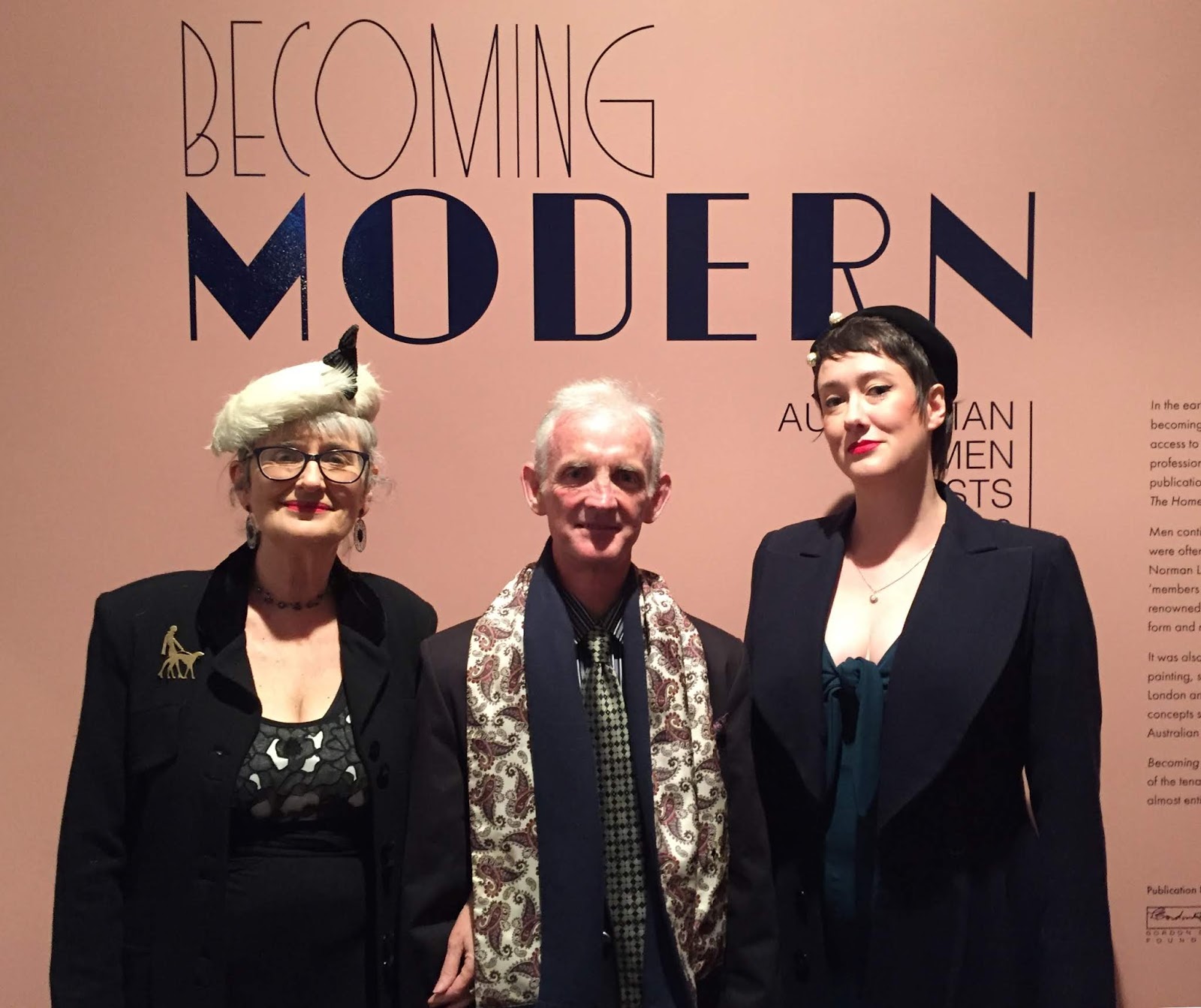
BECOMING MODERN


As an art student, back in the 1980s, I largely taught myself to make linocuts from examples in books, and Roger Butler’s catalogue of the relief prints in the permanent collection of the Art Gallery of Ballarat (1) was my bible. So you can imagine my excitement about BECOMING MODERN - AUSTRALIAN WOMEN ARTISTS 1920 -1950, which opened last week. Not only does it include many key works by the women artists in my still treasured catalogue, but also numerous examples of paintings, prints, sculptures and by other much admired Modernists, most them from the AGB’s own collection. 

Superlatives all the way for BECOMING MODERN and congratulations and thanks to Curator Julie McLaren, AGB Director Louise Tegart, and all those involved in putting together this superb show. I can’t wait to add the exhibition catalogue to my collection. To learn more about the show, visit the Ballarat Courier HERE.

Last Friday’s memorable opening night, for which we were invited to dress in the Modernist mode, was impeccably stage managed by AGB Marketing and Public Programs Officer, Peter Freund. In the top photo, I’m pictured with Thea Proctor’s iconic hand coloured linocut, The Rose (1927). What a thrill it was to see it in the flesh. (Photo credit: Shane Jones). 

Directly below, I'm with Shane Jones and BECOMING MODERN curator Julie McLaren. (Photo credit: Peter Sparkman).


BECOMING MODERN runs to 4 August. 

The show is a timely one in terms of the campaign 24 Hour Project: Know My Name at the National Gallery of Australia, which was also launched on Friday night. The campaign's aim is to draw attention to the work of creative women everywhere. It will take a damn sight longer than 24 hours for that to happen, but it's a positive start. As Nick Mitzevich, Director, National Gallery of Australia, states:

"We want to do more than have a conversation about equality, we want to take action and address the significant imbalance before us... The value of women artists in this country needs to be elevated as we are a thriving, diverse culture that should be celebrated.”


(1) Roger Butler, 1981, Melbourne Woodcuts and Linocuts of the 1920s and 1930s, Ballarat Fine Art Gallery, Ballarat, Vic. 

Thursday, May 16, 2019

Good news


In recent news, these things happened: whilst walking Alice last week, Shane received an extremely welcome phone call regarding his warehouse apartment in Abbotsford, which has been up for sale. Scroll through to see the happy outcome.


Of course, Alice is convinced it was the photo of her on the real estate sign (see below) that clinched it, and to be honest, the agent (whose advice throughout the whole process has been right on the ball) was keen to include her in at least one shot.


Thank you so much to everyone who left messages of support and encouragement when we placed the Abbotsford place on the market at very short notice, our fingers tightly crossed.


We celebrated with a celebratory glass of bubbles in the ACMI cafe before last night’s Cinematheque screening.


We’re still hard at work preparing my Ballarat house for sale. Meanwhile, we’re a step closer to moving into our Art Deco dream house and making Ballarat our permanent home.